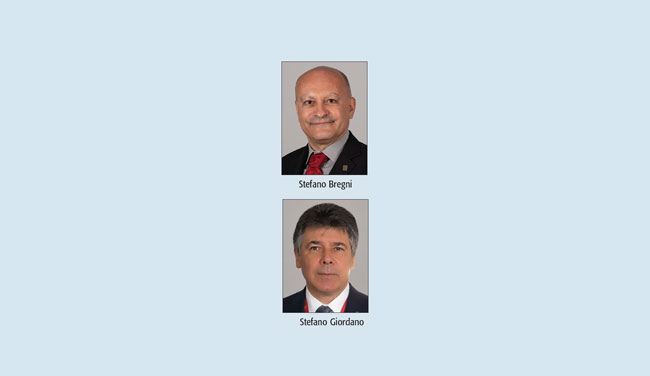
This article continues the series of interviews with the Officers of the IEEE ComSoc Member and Global Activities (MGA) Council for the term 2026–2027, which is published every month in the Global Communications Newsletter.
In this series of interviews, I introduce the Vice-President and the six Directors on the MGA Council (namely: Member Services, Industry Outreach, and AP, NA, LA, EMEA Regions), as well as the three Chairs of the Women in Communications Engineering (WICE), Young Professionals (YP), and Sister Societies Standing Committees. Additionally, I will introduce the Chair of the Communications History Committee, aligned under the Technical and Educational Activities Council. In each interview, they present their sector activities and plans one by one.
In this issue, I interview Stefano Giordano, IEEE ComSoc Director of the Europe, Middle East and Africa (EMEA) Region (2026-2027).
Stefano Giordano is a Full Professor in the Department of Information Engineering at the University of Pisa, where he obtained the M.S. and Ph.D. degrees. He has been an active IEEE volunteer for more than 38 years and has served in numerous leadership positions within the IEEE Communications Society. He currently serves his first term as IEEE ComSoc EMEA Region Director (2026–2027). His professional interests focus on integrating communication and processing technologies to advance networking and the Internet of Things, demonstrating the transformative impact of ICT, particularly in AgriTech and community networks that support rural connectivity.
Stefano: Hello Stefano! Would you like to begin by introducing the EMEA Region to our readers? What are its main characteristics? What areas does it include? Which Chapters have the most ComSoc Members?
Stefano: The IEEE Communications Society’s Europe, Middle East, and Africa (EMEA) Region, corresponding to IEEE Region 8, is far more than a geographical area: it is a remarkably diverse community of academics, industry professionals, students, and volunteers, representing 18.36% of IEEE ComSoc’s global membership.
Its extensive network includes 27 Chapters, 28 Joint Chapters, and 56 Student Branch Chapters, providing a strong foundation for cooperation across countries, generations, and technological domains. The region brings together mature research and innovation ecosystems, rapidly growing markets, and communities where access to reliable digital connectivity remains a major challenge. This diversity makes EMEA an extraordinary environment in which technological excellence can be translated into meaningful societal impact.
Based on the latest IEEE Region 8 membership dashboard and considering the total number of members across all membership grades, the UK and Ireland Chapter currently has the largest ComSoc membership in the EMEA Region. The Germany, Switzerland, Italy, Spain, France, Tunisia, Benelux, and Sweden Chapters follow it. These figures evolve continuously as members join, renew, change membership grade, or affiliate with different IEEE Societies. Nevertheless, the current distribution demonstrates the strength of both established European Chapters and rapidly developing communities, particularly in Tunisia in North Africa.
Stefano: This is your first time serving as IEEE ComSoc LA Region Director. How was your first impression when you were appointed? And on the first days, after you started serving in your new position? What was the first difficulty you faced?
Stefano: Within each IEEE Society, global initiatives address specific areas of research and innovation, and their outcomes are disseminated through flagship conferences, journals, and magazines (sometimes in close collaboration among different Societies).
However, few people are fully aware of the breadth of the activities carried out by IEEE Sections across different countries and by the local Chapters of its Societies. These initiatives span a wide range of areas, from humanitarian and historical activities to educational programs that extend well beyond merely scientific and technical aspects.
My experience as Chair of the Italian Chapter of the IEEE Communications Society gave me a deeper understanding of the relevance and impact of these initiatives. This form of volunteering provides valuable insight into societal needs and the importance of building a human-centric Society 5.0, in which Industry 5.0 will play a pivotal role.
One of the first challenges I faced was developing a comprehensive understanding of the breadth of IEEE ComSoc’s initiatives, which extend far beyond technical and standardization activities. They range from multimedia content creation and delivery to corporate programs and close engagement with local communities through Chapters and Student Branches.
Stefano: From your perspective as the EMEA Region Director, do you see any specific characteristics of your Region that make it challenging or different from other ComSoc Regions? What are the most significant challenges?
Stefano: A major challenge for the EMEA Region is turning its extraordinary diversity into consistent engagement across all Chapters. This diversity is particularly visible in Africa, the Middle East, and the Mediterranean, where the blue economy, harsh climatic conditions, energy and water constraints, vast rural areas, and limited infrastructure create distinctive engineering needs.
In these contexts, telecommunications are essential to economic development, education, healthcare, environmental monitoring, emergency response, and social inclusion. The Region therefore offers important opportunities for community networks, non-terrestrial communications, IoT, AgriTech, maritime connectivity, early-warning systems, and Smart Villages. Our role is to help Chapters transform local needs into shared, affordable, resilient, and sustainable solutions that help connect the unconnected.
Engagement nevertheless remains uneven. Although the IEEE Region 8 Chapter Chairs Congress, co-located with ICC 2026 in Glasgow, offered direct interaction with ComSoc leadership, only about one-third of the Region’s Chapters participated. Improving communication, awareness of available support, and the involvement of less-active Chapters, therefore, remain a key priority.
Stefano: How is the EMEA Region Board organized? What are its members and main activities? Did you set up specific working groups?
Stefano: The EMEA Regional Board adheres to IEEE ComSoc Policies and Procedures and brings together committee chairs, community representatives, and experienced volunteers. Its members are:
-
Technical Activities Chair (EMEAB-TAC): Toktam Mahmoodi
-
MSB EMEA Voting Representative and Membership Development Chair (EMEAB-MDC): Walter Cerroni
-
DLT and DSP Chair (EMEAB-DDC): Abdelhamid Mellouk
-
Awards and Young Researcher Award Program Chair (EMEAB-AC): Riccardo Bassoli
-
Information Services Chair (EMEAB-ISC): Lotfi Mhamdi
-
Industry–Academia Relations Chair (EMEAB-IRC): Valeria Loscri
-
Student Activities Chair (EMEAB-SAC): Laura Galluccio
-
Past Director: Javier Berrocal
-
Young Professionals Representative: Luca Borgianni
-
Women in Communications Engineering Representative: Lina Mohjazi
-
Student Member: Vignes Raman
I also appointed three advisors to support emerging regional initiatives: Capture the Flag (Lorenzo Bracciale), Communications History (Filippo Giannetti), and Amateur Radio (Gianluca Mazzini). They will help translate these ideas into activities involving Chapters, Student Branch Chapters, educational institutions, and local communities.
Stefano: What is the best news of this year in the EMEA Region?
Stefano: The best news this year is IEEE ComSoc’s commitment to investing in a broader and more interconnected portfolio of initiatives for Chapters, students, and members. Programs such as the Twin Chapters Program, Chapter Funding, the Regional Impact and Leadership Program, ComSoc Day, and joint TEA and Chapters activities will strengthen cooperation across geographical boundaries, enabling Chapters to share expertise, resources, and successful practices.
Particularly encouraging are the initiatives aimed at the next generation, including student project funding, competitions, mentoring, career fairs, Capture the Flag events, technology and leadership programs, free publication pages, and educational courses. Together with humanitarian activities, these programs can engage a wider, more diverse community and demonstrate the societal value of communication technologies.
Stefano: The Distinguished Lecturer Program (DLP) and the Distinguished Speaker Program (DSP) are particularly appreciated by our Members. What are the activities of your EMEA Region under these ComSoc Programs?
Stefano: As of August 20, 2026, the EMEA Region has the highest number of DLT and DSP activities across IEEE ComSoc, with 19 Distinguished Lecture Tours and 14 Distinguished Speaker lectures approved. These Chapter-initiated programs promote knowledge sharing, professional education, international expertise, and collaboration while demonstrating the vitality of our local communities.
Stefano: What other membership activities in the EMEA Region would you particularly highlight?
Stefano: I am particularly supporting three emerging initiatives that could strengthen Chapter collaboration and attract more students and professionals to telecommunications.
The first is a telecommunications-oriented Capture the Flag initiative, inspired by existing TLC Games and TLC Olympics. Unlike traditional cybersecurity challenges, it helps participants understand the identity of telecommunications and its relationship with computer science and electronics. Our goal is to develop a common format for schools, universities, and Student Branch Chapters worldwide.
The second focuses on amateur, or HAM, radio, combining education, communications history, propagation studies, and integrated sensing. Radio signals can support atmospheric and volcanic monitoring, while basic radio systems remain valuable for emergency coordination when critical infrastructure fails. This connects naturally with territorial resilience and Smart Village initiatives.
The third, Symphony at the Edge, was proposed by the EMEA Region to demonstrate the practical convergence of communications and computing. It enables professional and amateur musicians to perform remotely by combining low-latency applications such as JackTrip with private 5G and future 6G networks that offer appropriate quality of service, reliability, and service separation. It provides an engaging way to demonstrate the tangible impact of advanced communications technologies.
Stefano: And what about Students? Do you regularly organize any specific activities for them?
Stefano: Awareness of telecommunications as a distinct discipline has declined in several EMEA countries, affecting families, schools, and students. We must therefore emphasize that developments such as AI depend fundamentally on communications spanning integrated communication and processing in data centers, automation, AI for Networks, Networks for AI, and applications ranging from nanoscale to space communications.
The IEEE ComSoc Educational Services Board addresses this challenge through initiatives at all levels, including the ComSoc School Series and an expanding pre-university program that I am leading. Alongside ICC and GLOBECOM, we organize hands-on activities for secondary-school teachers, helping them understand the many dimensions of telecommunications and introduce the field to their students. These efforts have already produced two videos, an e-book, a dedicated educational publication, and numerous lesson plans.
Stefano: After students, what about Young Professionals and other engineers who are engaged in their profession in the industry?
Stefano: ComSoc Young Professionals include graduate students as well as early- and mid-career professionals in both academia and industry. This is a particularly important stage in their careers, when they can fully appreciate the value of IEEE membership and understand its evolution, from Graduate Student Member to leadership roles. ComSoc promotes several initiatives intended not only to attract Young Professionals, but also to encourage their active and sustained participation.
We are stimulating the chapters in this sense, including mentoring programs, career development events, networking opportunities, technical and leadership activities, and meetings with experienced professionals. These interactions allow senior members to share both the achievements and setbacks that shaped their professional careers. Through its Industry–Academia Relations Committee, Chapters, technical events, Distinguished Lecturer and Speaker programs, and networking initiatives, the EMEA Region strengthens connections between research, innovation, and industrial practice while highlighting the value of belonging to an international community such as IEEE ComSoc.
Stefano: What about Chapter Awards and funding?
Stefano: The EMEA Region maintains a structured awards program to recognize excellence across different dimensions of the ComSoc community. In 2026, the program includes the Industrial Researcher Award, the Outstanding Research Award, the Distinguished Service Award, and the Outstanding Young Researcher Award. Each award has one planned recipient and carries a USD 1,000 prize. Together, they recognize achievements in industrial innovation, outstanding scientific research, volunteer service, and the contributions of emerging researchers.
Starting this year, we have also introduced the Human-Centric Research Award. This new recognition is intended for individuals whose technical and scientific achievements have demonstrated a clear societal impact and contributed to the development of a human-centric Society 5.0 and Industry 5.0. It reflects our commitment to connecting research excellence with concrete human, industrial, and societal needs.
In parallel, we encourage Chapters to take full advantage of the funding opportunities offered by IEEE ComSoc for technical and educational activities, student and Young Professional engagement, Distinguished Lecturer and Speaker programs, and cooperation among Chapters. Funding should be regarded not only as financial assistance but also as a means of enabling Chapters to transform innovative ideas into visible activities with a lasting impact, both locally and across countries.
Stefano: What’s next? What are your plans for the end of 2026 and 2027?
Stefano: My plans are driven by a strong determination to create more opportunities for people to gain direct, tangible experience of telecommunications technologies and services as powerful drivers of transformation. The role of hyperconnectivity in Industry 4.0 clearly illustrates its impact. Demonstrating this value in practice will be essential to strengthening cooperation with industry, local communities, and public administrations. By connecting technical excellence with real societal needs, these initiatives can further consolidate the IEEE Communications Society’s leadership within IEEE’s family of Societies.
Stefano: That’s great! It’s good to read about so many new and well-established initiatives. A final remark to conclude this interview?
Stefano: My final thought is that the true strength of our community comes from bringing together the voluntary contributions of Chapters and Student Branches with those of all our members — from Young Professionals to experienced leaders, and from academia to industry. By sharing experiences and initiatives that extend well beyond conferences and publications, we can better understand the major challenges facing engineering, learn from past achievements and lessons, and connect technical excellence with humanitarian and educational action.
Just as we speak of “Big Science,” I believe we must restore strong attention to “Big Engineering”: the collective capacity to address complex, large-scale challenges and transform knowledge into practical solutions. When circumstances become critical, society looks to engineers for technical competence, resilience, and the ability to deliver tangible results that benefit everyone. IEEE ComSoc can play a central role in mobilizing this international community and turning its knowledge, creativity, and volunteer commitment into meaningful impact.