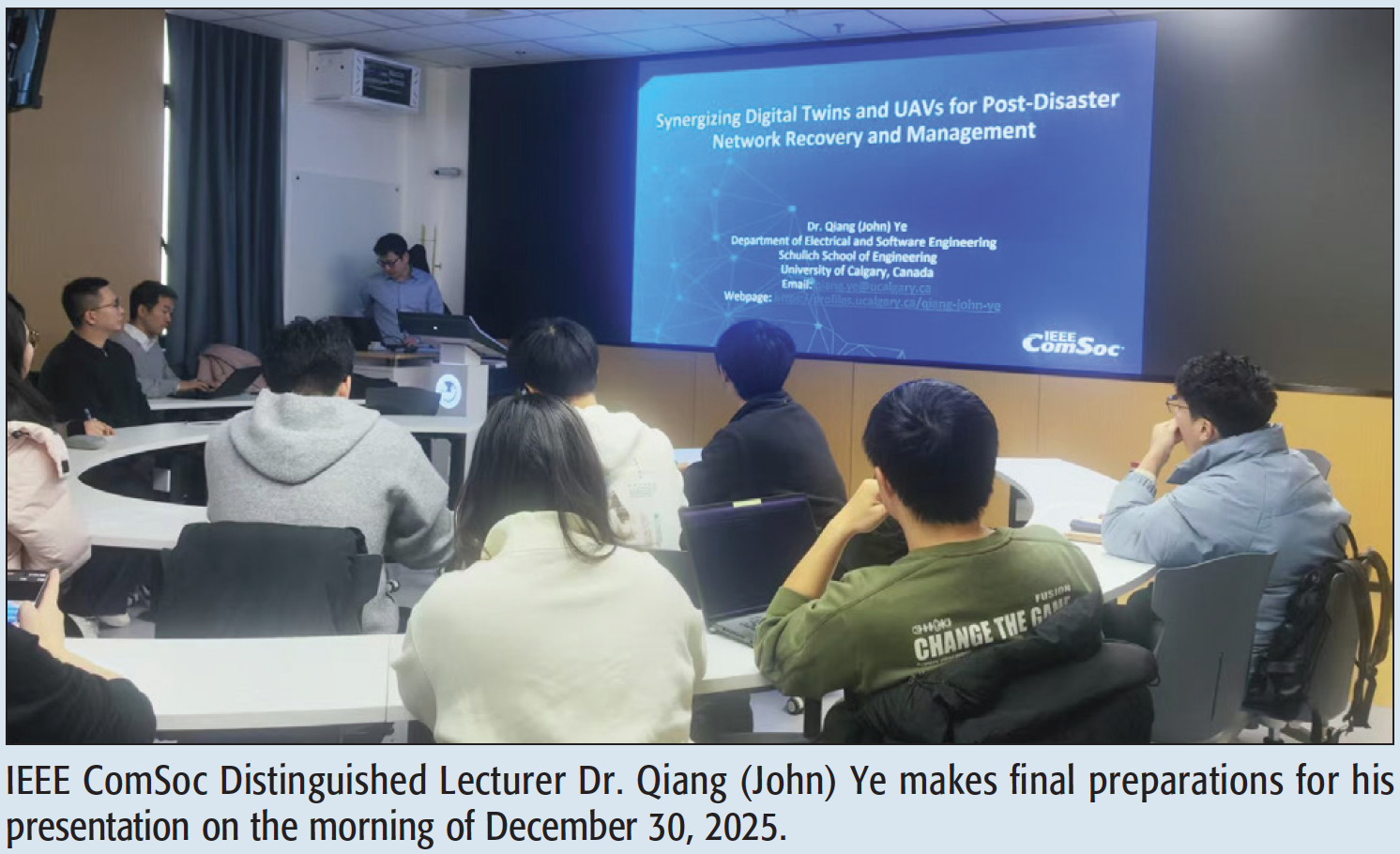
The IEEE Beijing Section Communications Society Chapter (IEEE COMSOC) was honored to host and organize the Distinguished Lecturer Tour (DLT) of Dr. Qiang (John) Ye from the University of Calgary, Canada. As a key promoter of academic exchange, our chapter facilitated this high-level technical activity to share innovative insights with the local research community. On Tuesday, December 30, 2025, Dr. Ye delivered a comprehensive technical seminar that brought together faculty members and graduate students specializing in next-generation resilient wireless networks.
The seminar, titled “Synergizing Digital Twins and UAVs for Post-Disaster Network Recovery and Management,” addressed the critical vulnerability of terrestrial communication infrastructures during natural catastrophes. Dr. Ye highlighted recent disasters, such as the 2024 Taiwan earthquake and Hurricane Maria, in which thousands of base stations were rendered inoperable, leading to severe disruptions in voice and data services and hindering vital rescue efforts. To overcome these challenges, he presented a framework that leverages Digital Twin (DT) technology as the intelligent “brain” for Unmanned Aerial Vehicle (UAV) swarms, enabling proactive and adaptive network restoration.
A central focus of the lecture was the introduction of two closed-loop DT lifecycles. The first, DT-C1, focuses on spatiotemporal network traffic prediction using Spatial-Temporal Graph Convolutional Networks (STGCN). To handle the partially collected or missing data common in post-disaster scenarios, Dr. Ye detailed the Spatial-Temporal-Aware KNN (STAK) data imputation method. Furthermore, a Residual-based Calibration (ResCAL) model was introduced to forecast future residuals and calibrate prediction errors, ensuring high-fidelity digital representations. The second lifecycle, DT-C2, governs hierarchical UAV deployment and resource allocation. This involves a Multi-Objective Optimization (MOO) approach to balance end-to-end throughput, user coverage, and deployment costs. Dr. Ye explained how Weighted Tchebycheff Scalarization can be used to solve these complex optimization problems.
The seminar also delved into the Clustered-Modular Mobility Model (Clustered-Mo3), which captures realistic, correlated user movement patterns during emergencies, such as community assembly for rescue or mass evacuation. Additionally, Dr. Ye showcased a practical testbed implemented via the Azure Cloud ecosystem, demonstrating how physical network data is processed through a unified digitalization layer to provide real-time insights and decision-making support.
Organizing this DLT presented unique logistical challenges, particularly in aligning international schedules to ensure our local community could access such specialized expertise. However, the DLT program’s reward lies in the bridge it builds between global innovation and regional application. What I found particularly impressive in this DLT was the seamless integration of theoretical models — like the three-stage smart city vision — with practical, life-saving communication solutions. The high level of engagement during the Q&A session, where students discussed edge collaborative inference and multimodal AIGC, underscored the value of this exchange.
Ultimately, this DLT successfully reinforced the Beijing Chapter’s commitment to advancing technical excellence and fostering international academic ties. By exploring the synergy between DTs and UAVs, our members gained a deeper understanding of how to build resilient communication infrastructure for the future. We look forward to continuing these initiatives to strengthen the global IEEE COMSOC community.