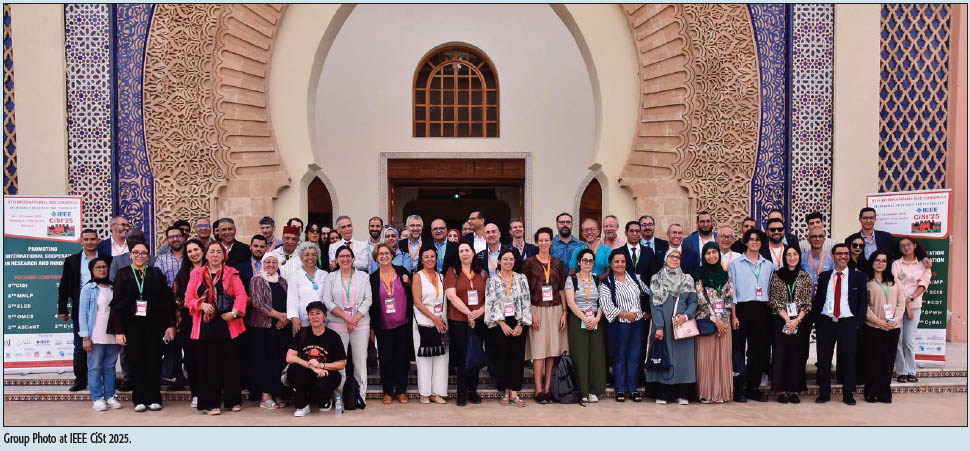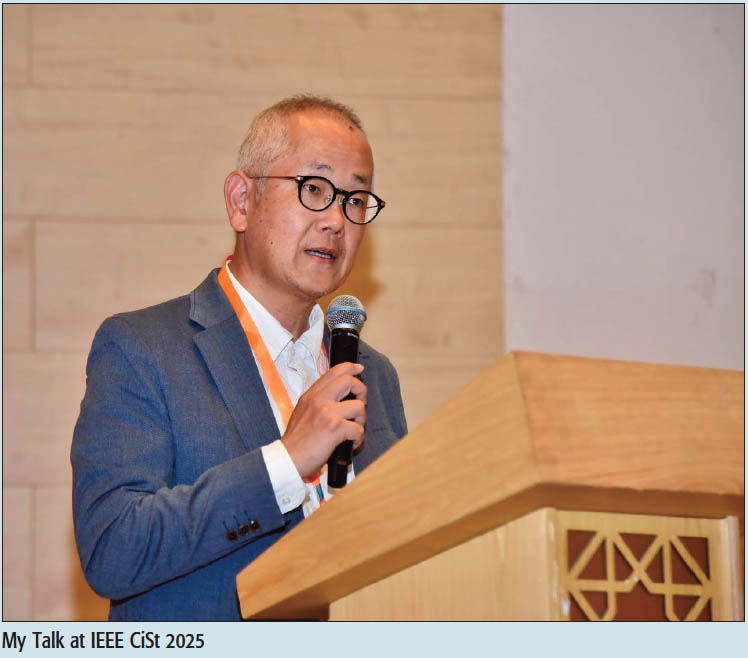
From October 6 to 8, 2025, I had the honor of visiting Morocco as part of the IEEE ComSoc Distinguished Lecturer Tour (DLT). The tour was graciously hosted by the IEEE Morocco Section in conjunction with IEEE CiSt 2025 — the 8th IEEE Conference on Information Science and Technology, a major biennial event uniting academia, industry, and students from across North Africa and beyond.
This DLT was made possible through the kind invitation and coordination of Prof. Mohammed El Mohajir, Chair of the IEEE Joint Morocco Computer ComSoc Chapter and Congress General Chair of IEEE CiSt 2025. The lectures were delivered from the main venue in Marrakesh and streamed to participants in Tangier, Rabat, and other universities across Morocco. Over three days, I presented talks on the evolving intersection of artificial intelligence, cybersecurity, and data-driven network management, engaging a diverse audience of professors, researchers, students, and professionals from telecom and IT sectors.
The Lectures
Deep Learning Fundamentals for Future Network Systems
The first lecture introduced deep learning and its adaptation to networked systems. While deep learning excels in vision and NLP, networking data poses unique challenges such as structured, high-volume telemetry and rare anomalies. I emphasized that deep learning must be context-aware to enable trustworthy, data-driven operations, concluding with my lab’s DREAM vision — Decentralized, Reliable, Efficient, AI-based Management.
Securing the Future: The Role of AI in Cybersecurity
The second lecture explored how AI, especially deep learning, is transforming cybersecurity. As threats evolve faster than ever, traditional defenses are no longer sufficient. I discussed AI-based intrusion detection and the need for continuous learning to address zero-day attacks and data drift, stressing that trustworthy, adaptive AI is vital for the future of secure networks.
Reinforcement Learning and Data-Driven Network Management
The final lecture presented reinforcement learning (RL) as a framework for sequential decision-making under uncertainty. After reviewing key algorithmic families — value-based, policy-based, and actor-critic — I illustrated a use case on deadline-aware scheduling of IoT tasks, showing how RL dynamically optimizes resource allocation. The talk concluded with challenges toward trustworthy RL: sample efficiency, scalability, interpretability, and integration with federated learning.
Discussion and Member Interaction
A highlight of the DLT was the active dialogue and curiosity of IEEE ComSoc members during and after each session. Conversations continued into coffee breaks and social gatherings, strengthening professional ties. Topics included Human vs. AI Programming, AI Security, Reinforcement Learning for Security, and Privacy and Data Access.
Among these, Human vs. AI Programming was especially thought-provoking. Participants reacted strongly to my remark: “Unlike Von Neumann-style computing, where humans write algorithms, AI learns algorithms from data.” I explained that while traditional computing relies on human-written programs, machine learning allows systems to learn task-specific algorithms directly from data.
One participant humorously noted that even in the Von Neumann era, with tools like ChatGPT, computers now write their own programs. This sparked discussion about the future of computer-science education and the growing importance of computational thinking — the ability to conceptualize and guide AI-driven systems rather than coding line by line.
Computational thinking is becoming central in modern curricula, emphasizing creativity, abstraction, and human-AI collaboration. Inspired by this exchange, I have begun reexamining how programming and computational thinking can be integrated into a coherent educational framework. These exchanges captured the spirit of the DLT — not only sharing technical insights, but inspiring future collaboration and friendship across borders.
Cultural and Social Activities
Beyond the sessions, I deeply appreciated the hospitality of our Moroccan hosts. Visits to the Medina, Ben Youssef Madrasa, and the House of Calligraphy revealed Marrakesh’s rich cultural heritage. Sharing tea surrounded by traditional craftsmanship reinforced the sense that international collaboration flourishes through both science and understanding.
A memorable day trip to Aït Ben Haddou and Telouet Kasbah was also organized. Aït Ben Haddou, a UNESCO World Heritage site, exemplifies southern Morocco’s traditional earthen architecture. Situated on the ancient caravan route linking the Sahara to Marrakesh, the fortified village once served traders of salt, gold, and spices. Its terraced clay dwellings and towers stand as a testament to Morocco’s pre-modern urban design and its role as a cultural crossroads between Africa, Arabia, and Europe. Further along the High Atlas Mountains lies Telouet Kasbah, the former seat of the Glaoui family, who ruled the region in the 19t–20th centuries. Though partially in ruins, the Kasbah preservesh stunning examples of Moroccan artistry — zellij tilework, carved cedar ceilings, and stained-glass mosaics — reflecting the fusion of Berber and Andalusian influences.
Sharing this journey with IEEE members and local organizers deepened our sense of connection through shared discovery and conversation, reminding us that lasting collaboration grows from mutual respect, curiosity, and friendship.
Impressions and Acknowledgment
The Morocco DLT was an inspiring blend of academic exchange, cultural discovery, and professional engagement. I am deeply grateful to Prof. Mohammed El Mohajir, Chair of the IEEE Morocco Joint Computer ComSoc Chapter and Congress General Chair of IEEE CiSt 2025, for his leadership and warm hospitality. His tireless efforts and dedicated team ensured success in every respect — from technical coordination to cultural immersion.
I also thank IEEE ComSoc for supporting the Distinguished Lecturer Program, which continues to build bridges among global research communities. The enthusiasm of the Moroccan participants reaffirmed the importance of collaboration in shaping the future of AI-driven networking. For local ComSoc members and students, the DLT offered practical guidance to initiate or expand research in AI-based network management; for me, it provided fresh perspectives and new partners — an invaluable return that will guide future DLP activities.