The IEEE Latin-American Conference on Communications (LATINCOM) is the region’s premier conference for advances in communications and networking. The 2025 edition was the 17th LATINCOM and marked the second time the event was hosted in Guatemala. Sponsored by the IEEE Communications Society (ComSoc), the conference brought together researchers, industry professionals, and students to present cutting-edge research, share insights, and foster collaborations across the Americas.
The 2025 conference took place from November 5 to 7, 2025, in Antigua Guatemala, a UNESCO World Heritage Site renowned for its well-preserved colonial architecture and vibrant culture. Participants enjoyed technical sessions set against the backdrop of volcanoes, cobblestone streets, and historic monuments.
Conference Venue
Antigua Guatemala was an ideal setting for LATINCOM 2025. Once the colonial capital of Central America, this small city was famous for its colorful facades, 16th- and 17th-century buildings and dramatic views of the Agua, Fuego, and Acatenango volcanoes. Attendees explored churches and ruins, enjoyed Guatemalan cuisine and coffee, and took excursions to nearby attractions, including the Pacaya volcano and Lake Atitlán. The city’s intimate scale and rich heritage provided a memorable backdrop for networking and collaboration.
Technical Program
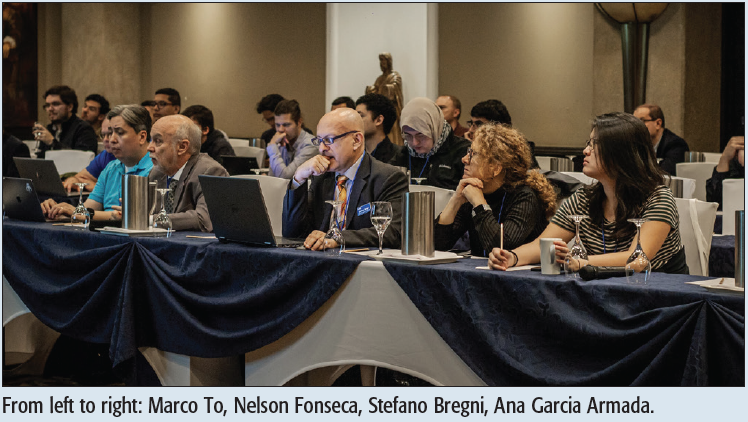
LATINCOM 2025 featured a comprehensive technical program that showcased the latest theoretical breakthroughs, technologies, and applications, as well as services in current and future telecommunication standards. The scientific and industrial programs included 4 keynote presentations, 5 tutorials, and 34 technical papers, which were presented in 8 thematic technical sessions, with an additional 7 papers and one keynote presentation part of a workshop. In addition, we were honored to have a special program co-organized by the ComSoc Women in Communications Engineering (WICE) and Young Professionals (YP) committees, which highlighted the essential role that women and the younger generations will play in advancing the information and communication technology sector.
During three days with several parallel sessions, the technical program covered established and emerging topics, organized in sessions about Communication Theory, Communications Hardware, ML for Communications, Wireless Communications and Networks, Networking, Security and Privacy, and Emerging Technologies.
Organizing Committee
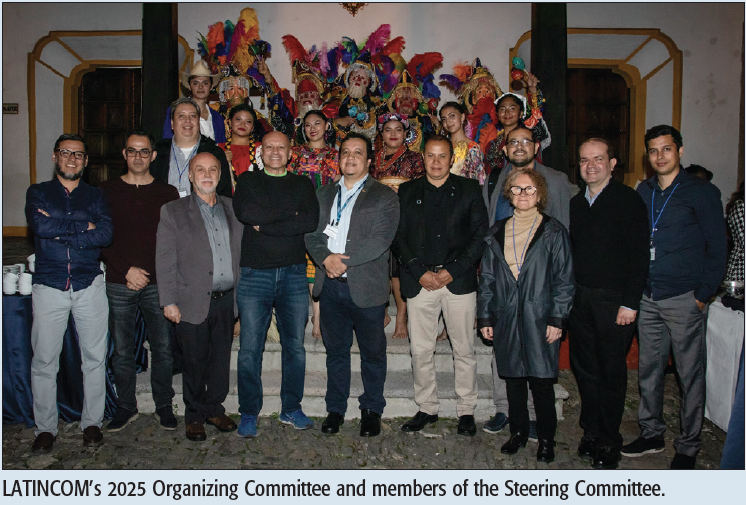
LATINCOM 2025 was organized by a dedicated team of volunteers from academia, industry, and the IEEE Communications Society. Key members of the organizing committee included:
-
General Chair: Juan David Alvarado Corado (IEEE Sección Guatemala, Guatemala)
-
Steering Committee Advisor: Marco Antonio To (Universidad Galileo, Guatemala).
-
Technical Program Committee (TPC) Co-Chairs: Ana García Armada (Universidad Carlos III de Madrid, Spain) and César Azurdia Meza (Universidad de Chile, Chile).
-
Keynotes & Tutorials Co-Chairs: Carlos Gutiérrez (Universidad de San Luis Potosí, México) and Miguel Gutiérrez Gaitán (Pontificia Universidad Católica de Chile, Chile).
-
Workshop Chair: Pablo Palacios (Universidad Diego Portales, Chile).
-
Local Arrangements & Finance Chair: Héctor Reyes (IEEE Sección Guatemala, Guatemala).
-
Treasurer: Bruce Worthman (IEEE Communications Society).
-
Sponsors & Patrons Chair: Christian Orellana (Universidad de San Carlos, Guatemala).
-
Publications Chair: Alberto Marroquín (Universidad Galileo, Guatemala).
-
Website Chair: Oscar González (Universidad Galileo, Guatemala).
-
Conference Planner: Shirley P. Cisneros (IEEE Communications Society).
In addition to the chairs listed above, the technical program committee was composed of leading researchers from universities and industry across Latin America, North America, and Europe.
Keynote Sessions
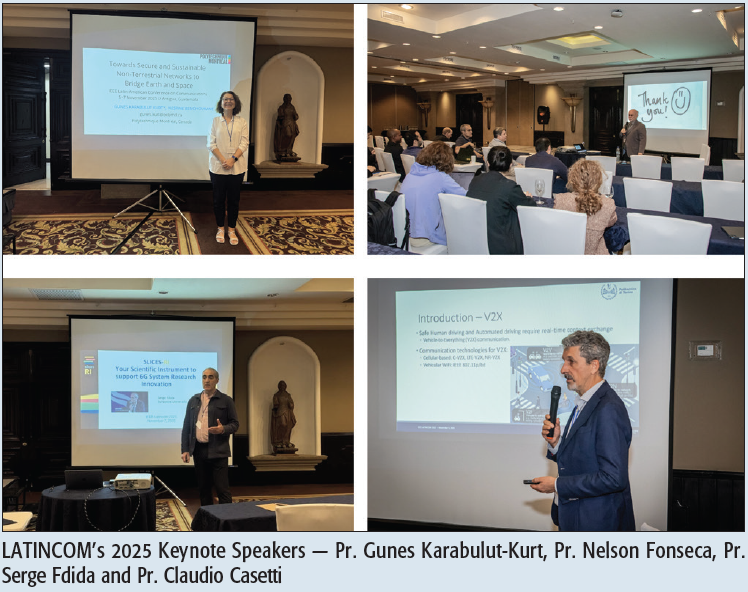
Four distinguished keynote speakers and one workshop keynote speaker shared insights on the future of communications:
Nelson Fonseca (University of Campinas — UNICAMP): Language Models for Network Configuration
Dr. Fonseca discussed how configuring modern networks to satisfy high-level intents is complex and time-consuming. He proposed using compact language models trained on a set of configuration tasks to automate network planning and performance optimization.
Claudio Casetti (Politecnico di Torino): Can Collective Perception Rescue V2X?
Prof. Casetti examined how vehicle-to-everything (V2X) communications struggle when adoption is low. By sharing raw sensor data across vehicles and infrastructure, collective perception could detect non-V2X-equipped objects and improve safety. The talk also discussed challenges in sensor fusion, data offloading, and edge processing.
Güneş Karabulut-Kurt (Polytechnique Montréal): Towards Secure and Sustainable Non-Terrestrial Networks to Bridge Earth and Space
Dr. Karabulut-Kurt presented a vision for integrating satellite mega-constellations with terrestrial networks via open radio access networks (O-RAN). She highlighted challenges related to interoperability, adaptive resource allocation, resiliency, and cybersecurity in non-terrestrial networks.
Serge Fdida (Sorbonne University): SLICES — Your Scientific Instrument to Support Future Networked System Research
Prof. Fdida introduced SLICES-RI, a European research infrastructure that provides reproducible experimentation for future networks. The talk covered how SLICES supports open data workflows, experimental orchestration, and shared hardware resources to accelerate innovation in communications.
Workshop Keynote — Rafael Pérez-Jiménez (Universidad de las Palmas de Gran Canaria): Beyond Vision: Optical Camera Communications for Wearable Communications
Pr. Pérez-Jiménez discussed how Optical Camera Communications (OCC) enable low-power, interference-free connectivity for wearables by utilizing cameras and LEDs as communication links. This keynote highlighted recent advances in OCC for wearable platforms and explored their potential for privacy-preserving, context-aware applications, as well as key research challenges in this emerging field.
Tutorial Program
LATINCOM 2025 offered a diverse set of tutorials that allowed participants to delve into specialized topics and gain hands-on experience.
Open RAN Security and Privacy
Madhusanka Liyanage, University College Dublin, Ireland, Engin Zyedan, Centre Tecnologic de Telecomunicacions de Catalunya, Spain, and Abdullah Aydeger, Florida Institute of Technology, USA.
Explored security and privacy challenges in open radio access networks (O-RAN), including threats to the disaggregated architecture, privacy in shared radio units, and control-plane vulnerabilities, and highlighted ongoing standardization and mitigation efforts.
Event Camera Communication
Rafael Pérez-Jiménez, Universidad de Las Palmas de Gran Canaria, España
Presented techniques for image-sensor-based optical communication in vehicular networks. The tutorial covered the use of vehicle cameras for visible-light and infrared communications (WOC), enabling robust communication between vehicles and road infrastructure in challenging environments.
Simulating Direct-to-Satellite IoT Networks with OMNeT++ and FLoRaSat
Alexander Y. Choquenaira-Florez and Juan A. Fraire, INRIA, France
Introduced FLoRaSat, an OMNeT++-based simulator for direct-to-satellite IoT networks using CubeSats. Participants learned how to model space-to-ground links, configure satellite constellations, and explore research directions in space-based IoT.
SLICES-RI 6G Blueprint Hands-On
Damien Saucez, INRIA, France; Nikos Makris, University of Thessaly, Greece; and Serge Fdida, Sorbonne Université, France
Provided hands-on experience with the SLICES research infrastructure. Attendees learned to orchestrate experiments using standardized APIs, allocate resources across distributed testbeds, and ensure the reproducibility of experiments.
Open6G-A 6G Blueprint
Abhimanyu Gosain, Northeastern University, USA
Discussed the envisioned architecture of 6G networks and the role of open research platforms such as Open6G-A in accelerating 6G development. Topics included 6G use cases, performance metrics, network virtualization, and open-source toolkits for early experimentation and development.
Workshop on Next-Generation Optical Wireless Communications
In conjunction with the leading conference, LATINCOM 2025 hosted a workshop titled “Next-Generation Optical Wireless Communications.” This workshop highlighted the latest breakthroughs in technologies like Visible Light Communication (VLC), Infrared (IR), and Free-Space Optical (FSO). This workshop addressed the growing demand for high-capacity optical wireless links and the limitations of radio-frequency spectrum. As RF spectrum congestion rises, optical wireless offers fast, secure, and interference-free alternatives.
Final Remarks
The 17th IEEE Latin American Conference on Communications was an exciting forum for researchers, practitioners, and students to share advances in communications technology. With a comprehensive technical program, distinguished keynote speakers, in-depth tutorials, and a topical workshop, LATINCOM 2025 highlighted innovations ranging from optical and non-terrestrial networks to collective perception in vehicular communications and AI-driven networking. Held in the historic city of Antigua Guatemala, the conference combined high-quality research with rich cultural experiences.