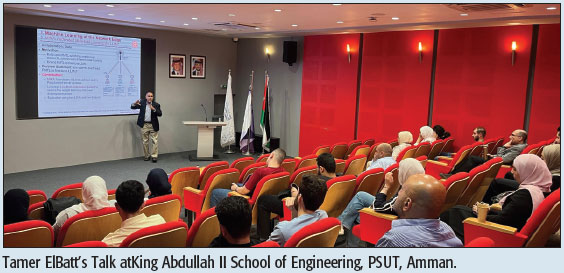
It is a great pleasure to report on my recent distinguished lecturer tour in the rich area of “Bilad Al-Sham,” a sub-region of West Asia that borders the Eastern Mediterranean, also known as the “Levant.” The tour was particularly in Jordan in July 2025. It involved three lectures at three leading academic institutions in Jordan. The talks gave rise to inspiring discussions, meetings, and interactions. The visit and follow-on discussions are expected to lead to collaboration opportunities. In addition, I had a chance to explore parts of the beautiful city of Amman and also visited the city of Irbid in the north.
In this DL tour, I delivered three talks scheduled as follows:
-
King Abdullah II School of Engineering, Princess Sumaya University of Technology (PSUT), Amman, hosted by Dr.Luae Al-Tarawneh (Chair of IEEE Jordan ComSoc/SPS Joint Chapter), July 20th, 2025.
-
School of Engineering, University of Jordan, Amman, hosted by Dr. Yanal AlFaouri, July 21st, 2025.
-
Communications Engineering Dept., Hijjawi Faculty of Engineering Technology, Al-Yarmouk University, Irbid, hosted by Dr. Sharief Abdel-razeq (Treasurer of the IEEE Jordan ComSoc/SPS Joint Chapter), July 22nd, 2025.
The focus of the talks was on emerging technologies and applications of machine learning over networks, including federated learning, AI for digital health, with a particular focus on the applications of federated and deep learning for heart monitoring, as well as Next G enabling technologies. In each talk, I overviewed research trends, recent results, and future research directions.
It was thrilling that the talks were well-attended by faculty members, peer researchers, and graduate as well as undergraduate students. The talks were followed by discussions about research challenges and ICT technology trends. For instance, the growing role of AI and machine learning to address societal challenges, including health, and green wireless networks leveraging RF energy harvesting, spurred interesting discussions and insightful questions by students.
In addition to the talks and fruitful academic exchanges in Jordan, I had the chance to gain a glimpse of the rich history and delicious food of this part of the world. My first lunch in Amman, a couple of hours after my arrival, was Jordan’s traditional Bedouin dish, known as “Mansaf,” made of tender pieces of lamb cooked in a sauce of fermented dried yogurt, “jameed,” served with rice and nuts. Amman is the capital of Jordan, its largest city, and is often referred to as the “City of Seven Mountains.” Each of these mountains forms the basis of a distinct neighborhood. It is located in the center of the country, in a hilly area between the desert and the Jordan Valley, not far from the Dead Sea (known to be the deepest hypersaline lake in the world). Jordan also boasts impressive Roman ruins and is known for its ancient city of Petra, the vast desert of Wadi Rum in the south, and the therapeutic Dead Sea, making it a popular destination for tourists from around the world.
On the last day of my tour, we took an interesting, scenic one-and-a-half-hour road trip north to Irbid, Jordan’s second-largest city. This was my first visit to the northern part of Jordan. The second-largest university in Jordan and the oldest in Irbid is Al-Yarmouk University, which hosted my last DL talk. The northern part of Jordan hosts a diverse agricultural landscape, including a rich history of olive tree plantations.
My DLT experience in Jordan was both memorable on a personal level and a successful professional networking opportunity. I had the opportunity to meet and interact with interested students and young researchers driven by their eagerness to learn, innovate, and make an impact. It was not only about sharing my research work and engaging in academic exchange, but also a unique chance to connect firsthand with researchers in Amman and Irbid, learning about the research priorities, challenges, and opportunities in this part of the world, as well as the culture and rich heritage. I highly recommend the ComSoc Distinguished Lecturer (DL) program to colleagues interested in expanding their research networks on the international level. I encourage researchers to apply to the ComSoc DL program, which is sure to have a positive impact on their careers. Through the collective efforts of ComSoc, the academic, and industry communities, we can share our work, learn about new initiatives, exchange ideas, and collaborate for the global social good.
The DLT tour provided ample opportunities for networking with peer researchers and students, sparking inspiring discussions on research, as well as food, history, and the cultural heritage of the vibrant “Bilad Al-Sham” area. In fact, the networking events following my talks led to further discussions about IEEE and its key role, identifying synergies and discussing potential collaboration opportunities. It is expected to lead to joint initiatives in the future.
