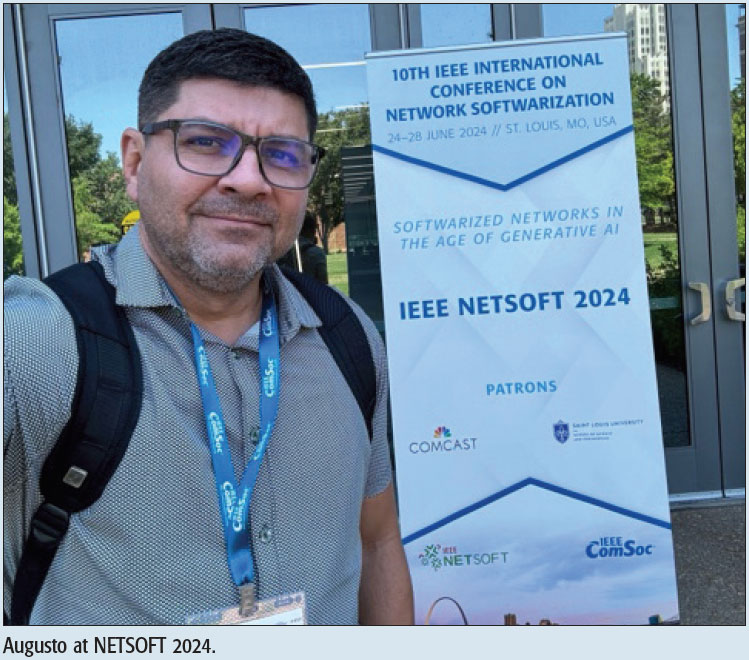
Reflecting on my Distinguished Lecturer Tours (DLTs) in 2024, I am pleased to share their profound impact on my professional growth and the expansion of my research network. The tours, which took place in the United States and Spain, provided valuable platforms to deliver lectures, engage in high-level discussions, and collaborate with leading researchers and academics in networking and telecommunications.
Through these interactions, I gained new perspectives on the latest advancements in Artificial Intelligence, Slicing, and Network-Applied Machine Learning. I also strengthened international research ties and explored new opportunities for collaboration.
DLT in the USA: Engaging with Innovation at St. Louis University and IEEE NETSOFT 2024
During my first DLT in the United States, I had the opportunity to deliver lectures at St. Louis University (SLU), hosted by Professors Flavio Esposito and Gianluca Davoli, and to participate in the 10th IEEE International Conference on Network Softwarization (Netsoft 2024), also held at SLU.
My lecture on “Cloud-Network Slicing: Concepts and Enabling Technologies” introduced the concept of network slicing, an essential technology in 5G and beyond, and showcased the latest advancements at LANCE, the research facility I lead at UFRN.
The students and faculty engaged actively, posing insightful questions and suggesting new avenues for research, which was one of the highlights of my visit.
My visit to SLU’s research labs also provided an in-depth look at testbed implementations and experimental validation of network functionalities, especially in software-defined networks. The collaboration discussions focused on overcoming performance, security, and interoperability challenges, which are crucial for the success of next-generation networking infrastructures. Participating in the IEEE Netsoft conference further enriched this experience by fostering discussions on bridging academia and industry, translating research into practical solutions, and the role of standardization and open-source contributions in accelerating technology adoption. These conversations opened doors for potential collaborations, including joint research initiatives and student exchanges.
DLT in Spain: Exploring Collaborative Synergies in Network Slicing and AI
In Spain, my DLT was hosted by Professor Javier Prieto, Chair of the IEEE ComSoc Spanish Chapter, and provided a unique opportunity to explore cutting-edge advancements in AI-driven network automation and machine learning for 5G networks. I visited renowned institutions, including the University of Valladolid (UVAL), University of Salamanca (USAL), and the IMDEA Networks Institute, where I delivered lectures on “Advancing Cloud-Network Slicing” and the integration of machine learning-driven load balancing in mobile networks.
At UVAL, I engaged with researchers working on AI and telecommunications, discussing potential collaborations on network virtualization, innovative healthcare applications, and AI optimizations. Similarly, at USAL, I explored the research ecosystem, which fostered stimulating discussions on AI-driven optimizations and network automation. These sessions sparked interest in exploring further partnerships, particularly in AI and machine learning applications for improving network performance and scalability.
The highlight of my Spain tour was the visit to IMDEA Networks Institute in Madrid, where I had the chance to explore the state-of-the-art research infrastructure and engage in deep conversations with researchers focused on AI-driven network optimization, edge computing, and network security. Our discussions revealed strong synergies with LANCE’s research, especially leveraging machine learning for enhanced network automation and efficiency. Following these interactions, I delivered a lecture that deepened these collaborations, with attendees expressing keen interest in joint research projects and knowledge-sharing initiatives. These connections reinforced the growing importance of interdisciplinary collaboration and the role of international partnerships in driving innovation in telecommunications.
The Importance of the Distinguished Lecturer Program
The IEEE ComSoc Distinguished Lecturer Program (DLP) plays a vital role in advancing the field of communications by promoting the dissemination of knowledge, fostering collaborations, and inspiring the next generation of researchers and practitioners. My experiences as a Distinguished Lecturer have allowed me to share insights from my research, learn from leading experts, and engage with vibrant academic communities. The DLP also provides an invaluable platform for building lasting relationships, exchanging ideas, and identifying new research opportunities that can lead to impactful innovations in the telecommunications sector.
In my view, the DLP is essential for expanding one’s research horizons and contributing to the collective advancement of the field. Through the program, we can ensure that cutting-edge research reaches a global audience, stimulate discussions on emerging topics, and spark new collaborations that push the boundaries of what is possible in communications and networking technologies. I strongly encourage all IEEE members to apply to the DLP, as it will provide unparalleled opportunities for professional growth and community engagement. Together, we can leverage our collective expertise to drive innovation and shape the future of telecommunications.
Conclusions
Reflecting on both my DLTs in the United States and Spain, I can confidently say that these experiences have greatly enriched my understanding of global research trends, while also providing valuable insights into the future directions of telecommunications. The exchanges with academics, researchers, and students and the discussions sparked during my lectures reaffirmed the importance of fostering international research collaborations. I look forward to the continued development of these partnerships and the exciting prospects for future research endeavors in the rapidly evolving field of network optimization and AI-driven communications.