The 5th edition of the IEEE Middle East & North Africa Communications Conference (IEEE MENACOMM’25) took place on 20–22 February 2025 at the Lebanese American University (LAU) in Byblos, Lebanon. Held under the esteemed patronage of His Excellency, General Joseph Aoun, President of the Republic of Lebanon, the conference highlighted the crucial role of scientific research and innovation in shaping the future of communications in the MENA region.
IEEE MENACOMM’25 (https://menacomm.org/) brought together researchers, academics, and industry professionals to exchange ideas and advance communications technologies. This year’s theme, “Breaking Boundaries: Pioneering the Next Era of Communication,” captured the spirit of exploration and innovation in the field. The conference envisioned a future where traditional limitations are overcome, paving the way for groundbreaking advancements in connectivity, knowledge-sharing, and collaboration. Participants were encouraged to challenge existing norms and contribute to shaping the trajectory of communication into uncharted territories.
The conference featured keynote speeches from distinguished experts, technical sessions showcasing cutting-edge research, and opportunities for collaboration among international participants. The three keynote speakers were:
-
Walid Saad, Professor at Virginia Tech, USA
-
Merouane Debbah, Professor at Khalifa University, United Arab Emirates
-
Pascal Lorenz, Professor at the University of Haute Alsace, France
-
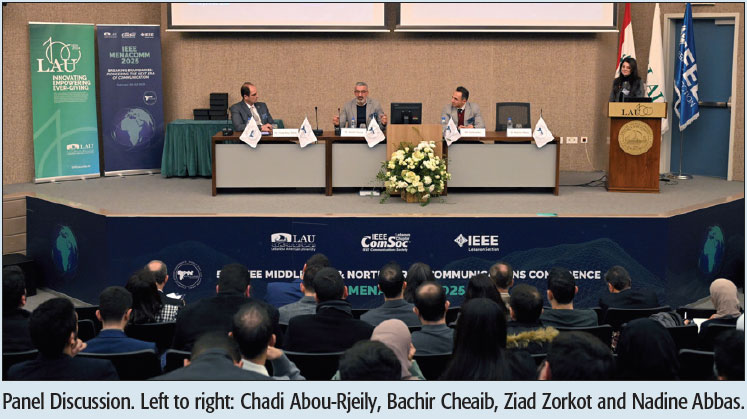
Additionally, the conference featured a panel discussion with distinguished experts from both industry and academia. The panelists included:
-
Ziad Zorkot, Director, Touch, Lebanon
-
Bachir Cheaib, Senior Sales Manager, Nokia, Lebanon/Jordan
-
Chadi Abou-Rjeily, Professor at Lebanese American University, Lebanon
This year’s event demonstrated remarkable resilience and commitment to scientific progress, attracting submissions from researchers worldwide. After a rigorous review process, 57 papers were accepted and presented in 10 technical sessions, maintaining a high standard of quality and impact.
IEEE MENACOMM’25 was co-organized by the IEEE ComSoc Lebanon Chapter and Lebanese American University, with technical co-sponsorship from a distinguished consortium of IEEE entities, including:
-
IEEE Lebanon Section
-
IEEE ComSoc Chapters from Lebanon, Bahrain, Cyprus, Egypt, France, Jordan, Kuwait, Morocco, and Tunisia
-
The Doctoral School of Sciences and Technology of the Lebanese University
-
The LaRRIS Research Lab of the Faculty of Sciences at the Lebanese University
-
The FEMTO-ST Research Lab, France
Since its inception, MENACOMM has been a premier platform for fostering collaboration and advancing cutting-edge research in communications technology. Following successful editions in Lebanon (2018), Bahrain (2019), Morocco (2021), and Jordan (2022), this year’s edition reaffirmed the conference’s role as a cornerstone event in the region’s research landscape.
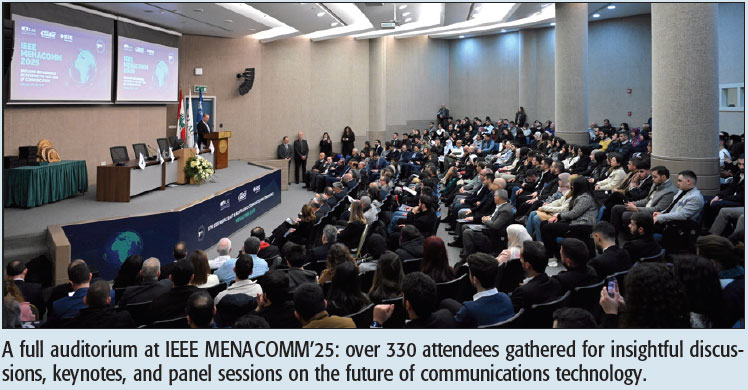
Despite Lebanon’s immense challenges due to ongoing conflicts, IEEE MENACOMM’25 was successfully organized, attracting 330 participants. The event provided a vibrant forum for networking, knowledge exchange, and discussions that will shape the future of communications technology.
A special acknowledgment goes to the Organizing Committee members, Lebanese American University, IEEE ComSoc Sister Chapters, IEEE ComSoc Lebanon Chapter volunteers, LAU Student Branch, Technical Program Committee Co-Chairs, General Co-Chairs, IEEE Lebanon Section, TPC members, Lebanese University, FEMTO-ST and all those who contributed to making this conference a success. Without their dedication and efforts, this achievement would not have been possible.
I would also like to extend my sincere gratitude to those who played a crucial role in overcoming the numerous challenges that threatened the organization of this conference in Lebanon. Thanks to Stefano Bregni, Habib Kammoun, Tiziana Tambosso, Hadi Kanaan, Mohab Mangoud, and Wafeeq Ajoor for their invaluable support.
The success of IEEE MENACOMM’25 reaffirms its role as a leading platform for advancing communications research in the MENA region and sets the stage for even greater achievements in future editions.