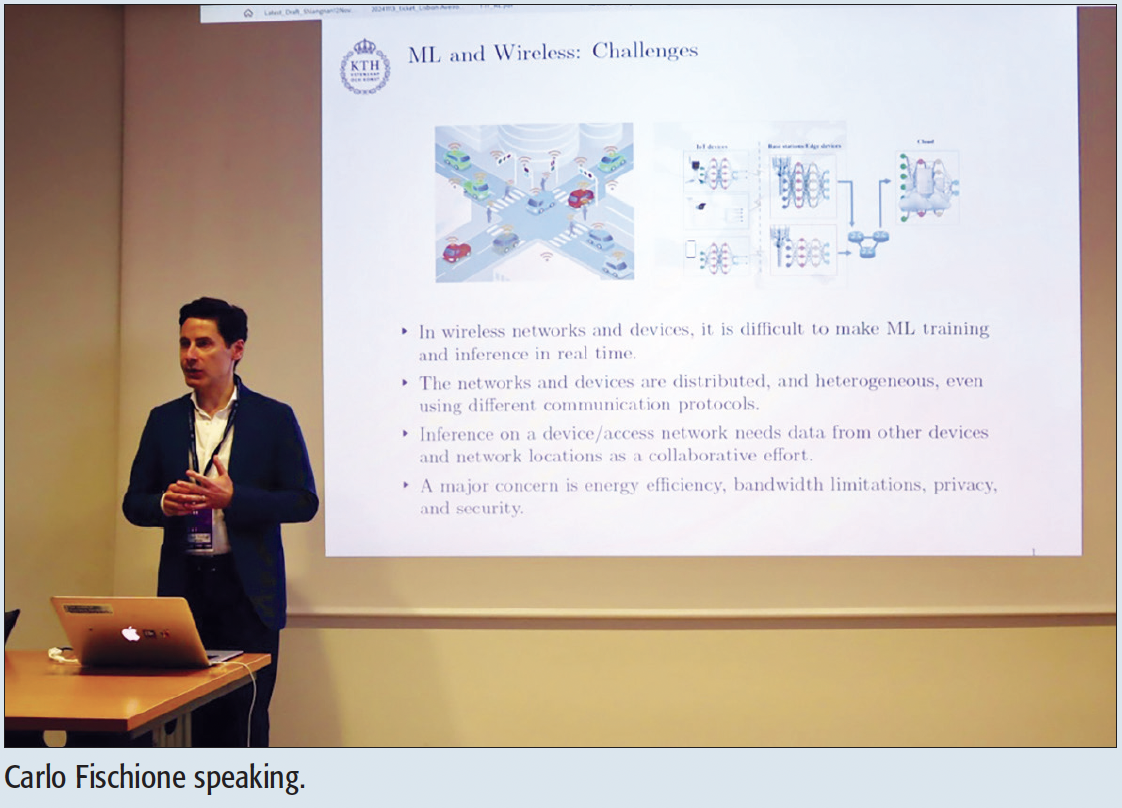
From the vibrant streets of Lisbon to the scenic landscapes of Aveiro and the mountainous charm of Covilhã, my Distinguished Lecture Tour (DLT) in Portugal was an inspiring exploration of wireless innovations. Throughout November 13, 14, and 15, 2024, I delivered three lectures on cutting-edge wireless communications and machine learning topics. These events brought together an audience of approximately 10-50 participants per venue, including students, researchers, and faculty members eager to engage in forward-looking discussions.
The Topics
Each lecture delved into a unique aspect of wireless and computational advancements:
Lisbon, NOVA FCT — Predicting the Quality of Service for Connected Vehicles by Machine Learning
Summary: Focused on utilizing machine learning to predict quality-of-service (quality of service) in cellular networks, particularly for connected vehicles. I introduced a federated learning framework that clusters geographical areas for localized prediction models, showcasing its superiority over traditional methods.
Takeaway: Attendees appreciated the relevance of machine learning to real-world challenges, especially in urban mobility. Researchers in the joint fields of wireless communication and robotics posed exciting questions about extending the research to flying drones.
Aveiro, Universidade de Aveiro — Analog and Digital Wireless Communications for Computations
Summary: Discussed Over-the-Air Computation (OAC) and the innovative ChannelComp approach, which leverages digital modulation for broader computational functions. Simulations demonstrated significant energy savings and enhanced spectral efficiency.
Takeaway: The audience was intrigued by the potential of digital OAC for future wireless networks, sparking a lively Q&A session, especially regarding industrial applicability.
Covilhã, Universidade Beira Interior — Channel Coding for Digital Wireless Computations
Summary: A novel scheme, Repetition for Multiple Access Computing (ReMAC), was presented to reduce computation errors in noisy and fading channels. The lecture explored optimization techniques and showcased performance improvements through simulations.
Takeaway: Researchers found channel coding and computation integration particularly innovative, initiating discussions on potential applications, especially within wireless sensor networks.
Why It Resonated
The extremely welcoming setting at each venue facilitated deep engagement and personalized interactions. Local participants were captivated by the practical implications of these advanced topics, bridging theoretical innovation with real-world applications. They appreciated the pedagogical clarity of the presentations, which made complex concepts accessible and inspiring, unlike presentations that give collections of visions.
Beyond the Lectures
Portugal’s cultural richness provided a perfect backdrop for the tour. Between sessions, I immersed myself in the country’s history and traditions, especially due to my deep interest in history and architecture:
Lisbon: A stroll through the iconic Belém district and visiting the Jerónimos Monastery offered a glimpse into Portugal’s maritime legacy. My hosts introduced me to the exquisite Vinho Verde, a low alcoholic white wine known by Seneca the Younger and Pliny the Elder almost 2000 years ago.
Aveiro: Known as the “Venice of Portugal,” the city’s colorful gondolas and tranquil canals provided a serene interlude. Here, I learned of the hundreds of recipes for cooking cod fish (bacalhau).
Covilhã: Nestled in the Serra da Estrela mountains, the region’s natural beauty and gastronomy left an indelible impression (not to mention the delicious local cheese Queijo da Serra da Estrela).
These experiences enriched the tour and sparked informal discussions with participants about the interplay between technology and culture.
Lessons Learned
Engagement Matters: Tailoring content to the audience’s background ensures better understanding and stimulates meaningful dialogue.
Cultural Context: Exploring local traditions deepens connections and broadens perspectives, making the DLT more impactful.
Emerging Trends: Portugal’s academic community is highly receptive to novel research, highlighting the potential for future collaborations.
Conclusion
My Distinguished Lecture Tour in Portugal was a remarkable journey of knowledge exchange and cultural discovery. The enthusiasm of local participants and the vibrant academic environment reaffirmed the importance of international engagement in advancing global research. I am grateful to my primary contact, Prof. Fernando Velez, and all the hosts, Prof. Luis Bernardo, Prof. Rodolfo Oliveira, and Prof. Daniel Nunes Corujo, for their exceptional hospitality.
I look forward to building on these connections.