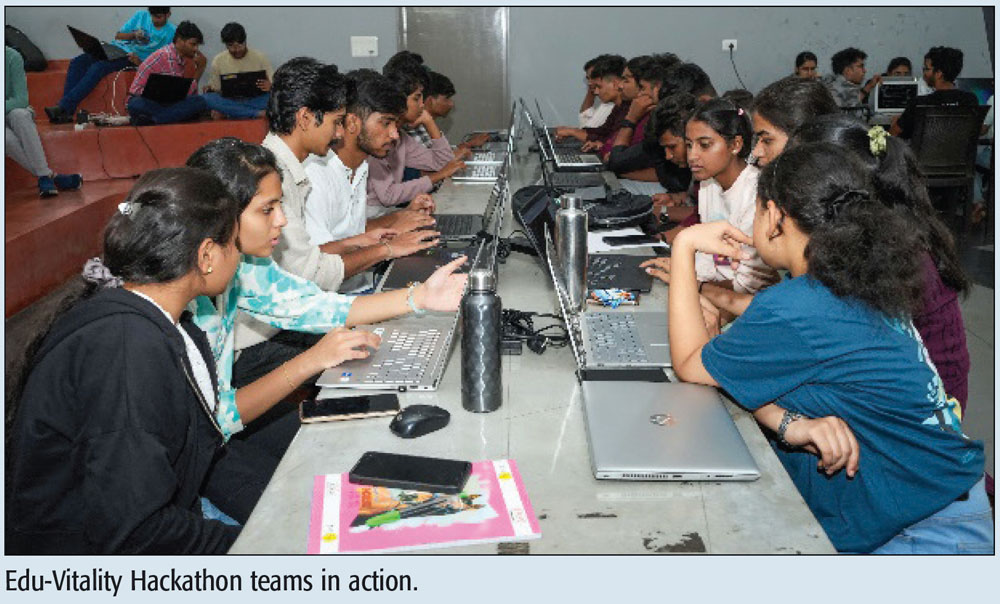
The recent Edu-Vitality Hackathon, organized by the IEEE ComSoC Bangalore chapter and sponsored by Intel at RV College of Engineering, brought together 47 teams of four members each to push the boundaries of technology. This event focused on developing innovative solutions for remote patient monitoring using IoT and personalized education using AI.
Held from June 7 to 8, 2024, this hackathon was more than just a competition; it celebrated creativity, collaboration, and the incredible potential of young innovators.
The event was a vibrant mix of energy, ideas, and innovation, divided into two primary tracks:
AI in Education: Teams utilized AI to enhance learning experiences and optimize educational outcomes, aiming to transform the educational landscape.
IoT in Healthcare: Participants developed secure IoT systems using wireless protocols and AI algorithms to remotely monitor vital signs, medication adherence, and disease progression.
Of the 47 participating teams, 11 chose to tackle IoT healthcare challenges, while 36 focused on AI in Education. With no constraints on the problem statements, participants could innovate and present unique solutions.
The hackathon kicked off at 4:30 PM on Friday and continued until 9 AM on Saturday. During this time, the space buzzed with activity as participants coded, designed, and debugged through the night, turning their ideas into tangible prototypes.
On Saturday morning, the focus shifted to evaluation. The panel included ComSoc members, Academia professors, and Intel technologists for both tracks. The projects were meticulously reviewed, and I was impressed by the ingenuity and practical applications presented by the teams. The results were announced after lunch, around 3 PM. Prizes were distributed to the winners and runners-up for each track and a special award for the best overall UX design.
Additionally, the selected 9 outstanding teams were invited to a one-day workshop at Intel India on AI PC on July 5th, 2024, which provided them with an opportunity to refine their projects, integrate the OpenVINO™ toolkit, and gain insights from industry experts.
The workshop included sessions by experts on varied topics.
-
“Introduction to Intel Ultra Architectures and OpenVino”: Sanjay Aghara, System Software Architect, provided a view of Intel’s cutting-edge architectures and the powerful OpenVino toolkit, which facilitates the deployment of AI models.
-
“Machine Learning Processes, Overview of Regression, and Deep Learning”: Saurabh Tiwari, Senior Principal Engineer, provided a comprehensive overview of machine learning processes and a deep dive into regression techniques and deep learning methodologies.
-
“Comprehensive Hands-On Session on OpenVINO”: Pooja Baraskar, Developer Advocacy Program, led an engaging hands-on session.
Participants gained invaluable insights into OpenVino and the pioneering research on Neural Processing Units (NPUs). The knowledge and skills acquired ignited them further towards innovation in AI technology.
This hackathon was more than just a competition; it was a testament to what can be achieved when bright minds come together with a shared purpose. The judges were impressed by the technical skills displayed and inspired by each participant’s passion and dedication. The seeds of innovation planted in this hackathon will continue to grow, driving innovation. The future is bright, and events like this light the way.
A special thanks to Kannan Babu Ramia, Senior Principal Engineer, Edge Computing, Intel, and his entire team for driving the Edu-Vitality hackathon along with IEEE ComSoc Bangalore Chapter exec members and orchestrating the fantastic workshop.