The 3rd edition of the Women in Smart Communications (WiSC) Workshop took place on July 10, 2024, showcasing leading female experts in wireless communication technologies from both academia and industry. Organized by IEEE WIE UK & Ireland, IEEE ComSoc UK & Ireland, IEEE WIE IEEE ComSoc Spain, and IEEE WICE, the event offered a platform to discuss cutting-edge developments in smart communication networks alongside fostering youth empowerment in network design and innovation.
Chaired and moderated by Dr. Lina Mohjazi, Assistant Professor at the University of Glasgow, the workshop hosted Technical Talks and a Panel Discussion, delivering thought-provoking insights into the advancements of smart wireless communications and the role of women in pushing the boundaries of this rapidly evolving field.
Technical Talks: Insights into the Future of Wireless Communication
The first session featured inspiring technical talks from renowned female experts from academia and industry, who shared groundbreaking research and innovation shaping the future of wireless networks.
Prof. Sinem Coleri from Koc University, Turkey, presented her talk titled AI-Based Ultra-Reliable Wireless Networked Control Systems in 6G. Her presentation delved into the transformation of wireless communication from human-centric networks to the machine-driven world of 5G and beyond. She explored how generative AI and optimization techniques are being applied to ultra-reliable channel modeling, pushing the boundaries of control systems in 6G networks. The use of AI promises higher accuracy and adaptability, enabling new applications like remote surgery and autonomous vehicle platoons.
Dr. Francesca Marcello from the University of Cagliari, Italy, discussed Empowering Wellness: Human Behaviour Recognition for Well-being and Sustainability. Her research focuses on how the Internet of Things (IoT) and behavior recognition technologies can optimize energy usage and improve user well-being in smart buildings. Through advanced sensor networks and wearables, her work highlights how monitoring human habits can lead to behavioral changes that benefit both personal health and the environment.
Dr. Marta Orduna from Nokia, Spain, explored the potential of inclusive technology in her talk titled INCLUVERSO 5G — Inclusive Immersive Communication Experiences Over 5G Networks. Dr. Orduna’s research in immersive communications aims to promote inclusion, particularly for individuals with psychosocial vulnerability. Her work within the INCLUVERSO 5G project demonstrates the possibilities of using XR technologies to provide virtual training and remote assistance to vulnerable communities, all supported by private 5G networks.
Prof. M. Julia Fernández-Getino García from Universidad Carlos III de Madrid, Spain, wrapped up the session with her talk, Challenges in Pilot Transmission for Multicarrier-Based Communications Towards 6G. Prof. García’s research tackles the challenges of pilot transmission in upcoming 6G networks. With the ever-increasing demand for data, she discussed alternative strategies for efficient channel estimation and synchronization, paving the way for the high-mobility and long-distance applications of the future.
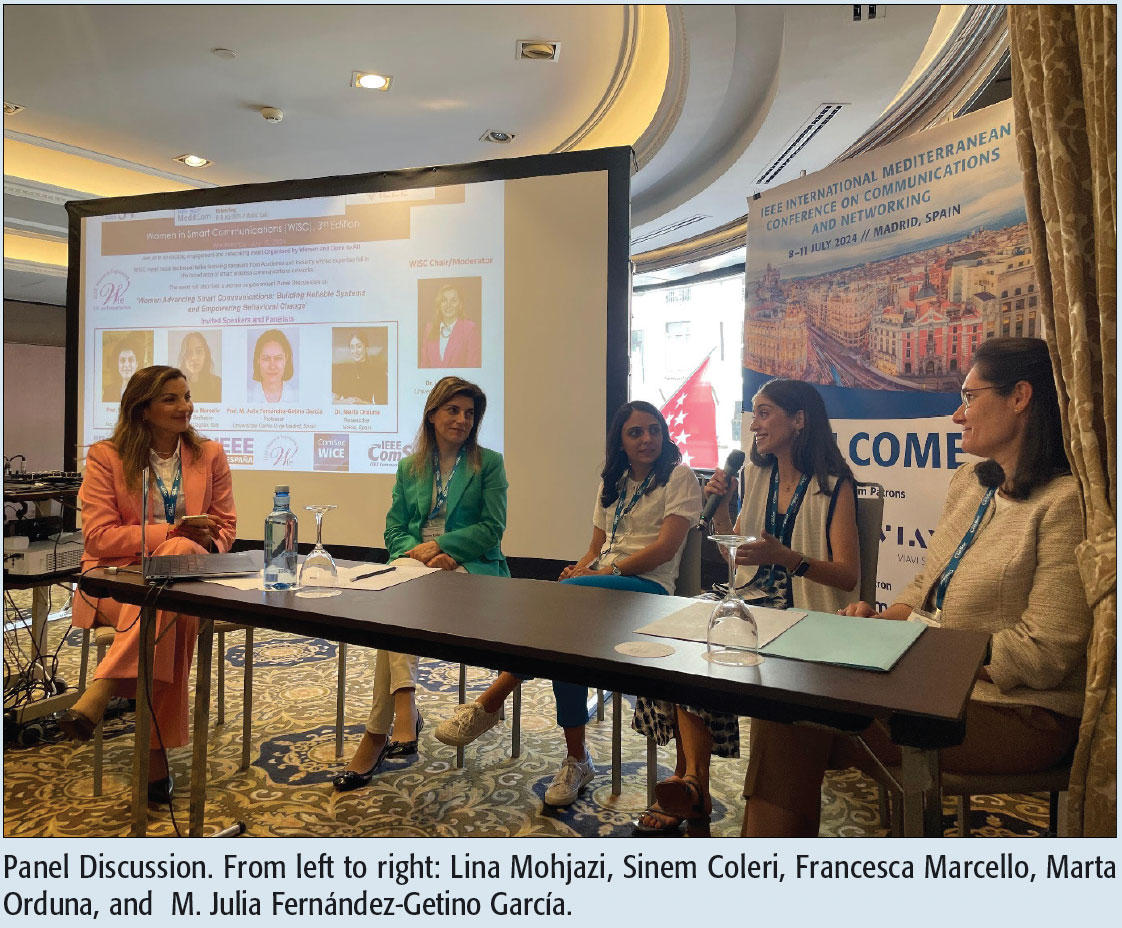
Panel Discussion: Women Advancing Smart Communications: Building Reliable Systems and Empowering Behavioural Change
Following the technical talks, the event continued with an engaging panel discussion titled Women Advancing Smart Communications: Building Reliable Systems and Empowering Behavioural Change. Reflecting on their career journeys, the panelists discussed strategies to empower young innovators in network design and modeling. The panel focused on the need for mentorship and skill development to enable the next generation of leaders in the field to build more reliable and sustainable systems. The panel also discussed how to navigate the career challenges in a man-dominated field.
With a commitment to fostering innovation and promoting gender equality in the field, the WiSC Workshop was attended by 50 in-person and online attendees and received significant engagement and interest. The event stood as a beacon of inspiration for young professionals, particularly women, looking to make their mark in smart communication technologies.
This year’s WiSC event truly highlighted the intersection of technology and societal impact, with women leading the charge toward a more connected, sustainable future.
