The 2024 IEEE/IFIP Network Operations and Management Symposium (NOMS 2024) was held at the K-Hotel Seoul during May 6–10, 2024, in the vibrant city of Seoul, Korea. It was a momentous occasion as NOMS returned to Korea after 20 years, following the successful NOMS 2004. The conference theme for NOMS 2024 was “Towards intelligent, reliable, and sustainable network and service management.” As technology evolves, we witness the rapid deployment of 5G networks worldwide and the emergence of 6G on the horizon. Backbone networks, optical networks, and their convergence play pivotal roles in supporting mobile/wireless networks, the Internet of Things (IoT), metaverse applications, smart cities, autonomous vehicles, healthcare, and network twins. Exciting advancements like generative AI and large language models (LLMs) are reshaping the landscape of network operations and management.
Keynotes
The conference featured six keynote addresses by distinguished experts from academia, industry, and government. Jinbae Hong, President of IITP, Korea, gave the first keynote titled “Network Innovation and the Future of Digital Transformation in Korea.” The second keynote was delivered by the Head of Network R&D Lab at KT (Korea Telecom), Jongsik Lee, and the title of “AI-Driven Evolution of Cloud-Native Networks.” The third keynote was given by Deep Medhi, Program Director at NSF, USA. Deep gave a talk on “Networking, Distributed Computing and Systems due to Huge Scientific Workflows with Implications for Monitoring and Management,” The fourth keynote speech was given by Prof. Hanna Bogucka from Poznan University of Technology, Hungary with the title of “Security of Open Radio Access Networks.” The fifth keynote was delivered by Charlie Zhang, EVP, of Samsung Electronics, with the title of “6G: Future Telecom for the AI Era.” The sixth and last keynote was delivered by Laurent Ciavaglia, Head of Network Management Data and Intelligence, Nokia with the title of “What if Networking,” giving a visionary exploration of the future networking, integrating network digital twins, AI advancements, and sustainable practices.
Distinguished Expert Panel
A Distinguished Expert Panel titled “Securing Critical Infrastructure: Navigating IoT Challenges and Ensuring Systematic Visibility” was held as the last session on the fourth day of the symposium to explore cloudification, AI/ML integration, and advancements in mobile networks towards 6G. The DEP panelists were Hanna Bogucka (PUT, Poland), Laurent Ciavaglia (Nokia, France), Hyungoo Lee (Ericsson-LG, Korea), and Alberto Leon-Garcia (U. of Toronto, Canada).
Panel Sessions
The conference included five-panel sessions covering various hot and timely topics:
Panel 1, Securing Critical Infrastructure: Navigating IoT Challenges and Ensuring Systematic Visibility — discussed the challenges and importance of enhancing visibility to manage cybersecurity risks in critical infrastructure, with a focus on the Internet of Things (IoT).
Panel 2, Advances and Impacts of SmartNICs in Modern Data Centers — reviewed recent advances and research challenges in SmartNICs, exploring their rapid evolution and significant impact on network processing and data center operations in the era of Artificial General Intelligence.
Panel 3, Global Insights: Exploring International Research Funding Opportunities — illuminated international funding opportunities for research across various disciplines, covering strategies for building partnerships and understanding successful application criteria, thereby helping attendees better leverage grants and navigate collaborative projects to advance their research.
Panel 4, Digital Network Twins for Network Management — aimed to unite researchers, experts, and practitioners to share insights and discoveries, fostering collaboration and innovation to address the challenges and opportunities in the evolving field of network digital twins.
Panel 5, Generative AI for Network Management — highlighted the strategic application of data-driven AI to enhance efficiency and innovation in managing complex network systems, previewing discussions for the GAIN Workshop and offering thought leaders a platform to share visions, debate challenges, and explore the integration of Generative AI into network management for greater automation and sustainability.
Tutorials
Eight tutorials on hot and timely topics were offered to the attendees to provide in-depth knowledge and use cases on the first day and last day.
Tutorial 1: Optimization for Network Digital Twins
Tutorial 2: QUIC Protocol Security
Tutorial 3: Reinforcement Learning in Network Protection
Tutorial 4: Greening Networks for Sustainability
Tutorial 5: Reputation Systems in 5G/6G Networks
Tutorial 6: Adaptive Video Streaming
Tutorial 7: Multi-5G/6G Autonomous Networks Federation
Tutorial 8: Integrity Attestation in Distributed Infrastructures
Full Paper Technical Sessions
50 full papers in 13 technical sessions were scheduled and presented throughout the conference, focusing on critical areas like network security, generative AI for network management, AI for SDN/NFV, monitoring, traffic management, IP networks, AI applications, performance management, cloud management, and edge networks. AI was a hot enabling technology that was being used in many aspects of network and service operations and management this year.
Mini-Conference Sessions
33 short papers were presented in eight mini-conference sessions on the first day and last day and covered emerging research in 5G/6G technologies, federated learning, blockchain, IoT, security, communication protocols, AI, and performance management. Each session was chaired by experts from leading academic and research institutions.
Experience Sessions
Experience sessions presented papers that dealt with various experiences in actual operations and management by various telcos and service providers. This year they focused on network monitoring, orchestration, and security. AI/ML network services, RAN energy consumption, and SDN-based network slicing.
Poster Sessions
Six poster sessions provided a platform for presenting cutting-edge research on network technologies, security, AI/ML, IoT applications, cloud computing, and data analytics.
Doctoral Symposium
The doctoral symposium offered a venue for Ph.D. students to present their research on networks, softwarization, and security. Sessions were chaired by leading researchers, providing valuable feedback and networking opportunities.
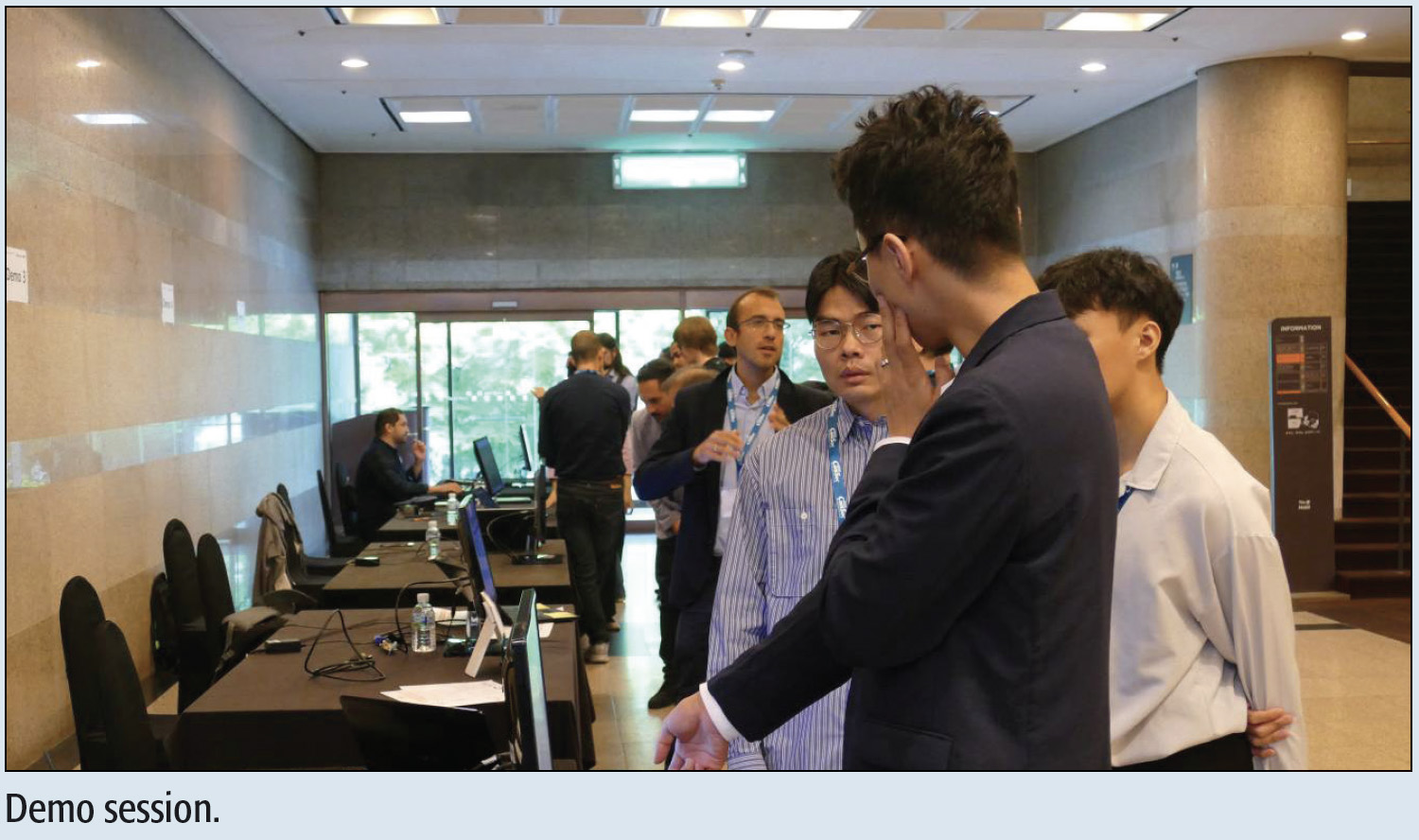
Demo Sessions
There were 15 demos for three days of the conference, each day with 5 demos. The demos included demonstrations of research prototypes on the following topics:
-
Dynamic management of Bluetooth Mesh Networks using Digital Twin technology.
-
Preparations for the 6G era with the Internet of Edges.
-
Orchestration of multi-tenant code updates across programmable switches.
-
Verification of telecom service fulfillment procedures using Digital Twin.
-
Hierarchical software-defined control for coordinated RAN and PON-based transport scaling.
-
Detection of silent network failures.
-
AI/ML proactive network service relocation for multi-admin domain scenarios.
-
Energy consumption demonstrations of radio access networks in container clouds.
-
Reliable cloud-native 5G and beyond networks using in-network computing.
-
An adaptable AI assistant for network management.
-
Rapid prototyping of network-slicing solutions in SDNs.
-
Virtual lab frameworks for teaching network automation and SDN.
-
SDN-based mitigation of synchronization attacks on microgrids.
-
Dynamic QoS for high-quality SD-WAN overlays.
-
Network security automation with a demo playbook for posture assessment.
Workshops
There were six co-located workshops on Monday and Friday. The following were the workshops and the latest hot topics they focused on:
-
AnNet 2024: Focused on AI and data analytics for network services.
-
MFI5.0 2024: Discussed on Industrial AI and cyber-physical production systems.
-
Manage-IoT 2024: Addressed IoT management in the compute continuum.
-
IPSN 2024: Explored AI/ML for networking with programmable data planes.
-
ANMS-TNT-QoDaNet 2024: Discussed autonomous network management, network digital twins, and data analytics.
-
GAIN 2024: Explored generative AI for network management.
Exhibitions
Leading companies and institutions like KT, Chunghwa Telecom, Arista Networks, Nokia, and INSoft exhibited their latest technologies and solutions in the network and service management space.
Banquet
The conference Banquet was held on the evening of the third day and featured a buffet of Korean food including Kalbi, raw fish, a variety of vegetables, kimbap, japchae, chicken, pork, beef, seafood, and an assortment of desserts that can be enjoyed by everyone including vegetarians and vegans. We had an exciting K-Pop girl group performance by 1CHU. They sang and danced four of their popular songs and got the attendees on their feet to watch and take videos and photos. We then had a brief memorial presentation of the late Dr. Masayoshi Ejiri who passed away last year, Dr. Ejiri was a father of network operations and management from Japan and is remembered by colleagues from around the world. We also had a publicity announcement of video clips of CNSM 2024 which will be held in Prague, Czech Republic this fall, and NOMS 2025 in Hawaii in May 2025.

Conference Statistics
In this year’s edition of NOMS 2024, we have received 170 paper submissions, which have been contributed to by 461 authors from 31 countries. In addition, eight workshops had been co-located with the main conference. Out of these overall submissions, about 38.2% were from Asia/pacific, 37.1% from Europe, 22.4% were from America, and 2.4% from Oceania. While each paper had received at least three reviews, including 67% with 4 or more reviews, from the technical program committee consisting of 204 experts in total, overall, 221 papers (including workshops, experience, demo, doctorial symposium, and excluding 1 No-show paper) were retained to appear in the proceedings in its different categories.
Through this rigorous process, the program compiled shows a very high quality: only 50 full papers have been selected for the 13 technical sessions, corresponding to a competitive acceptance rate of 29.4%. Selected NOMS 2024 best papers were invited to submit an extended version of their papers to Wiley’s International Journal of Network Management with a fast-track review process. Additionally, 33 mini-conference papers, 48 poster papers, and 8 experience papers have been accepted to the conference program. Moreover, 15 demo papers and 12 doctorial symposium papers were accepted.
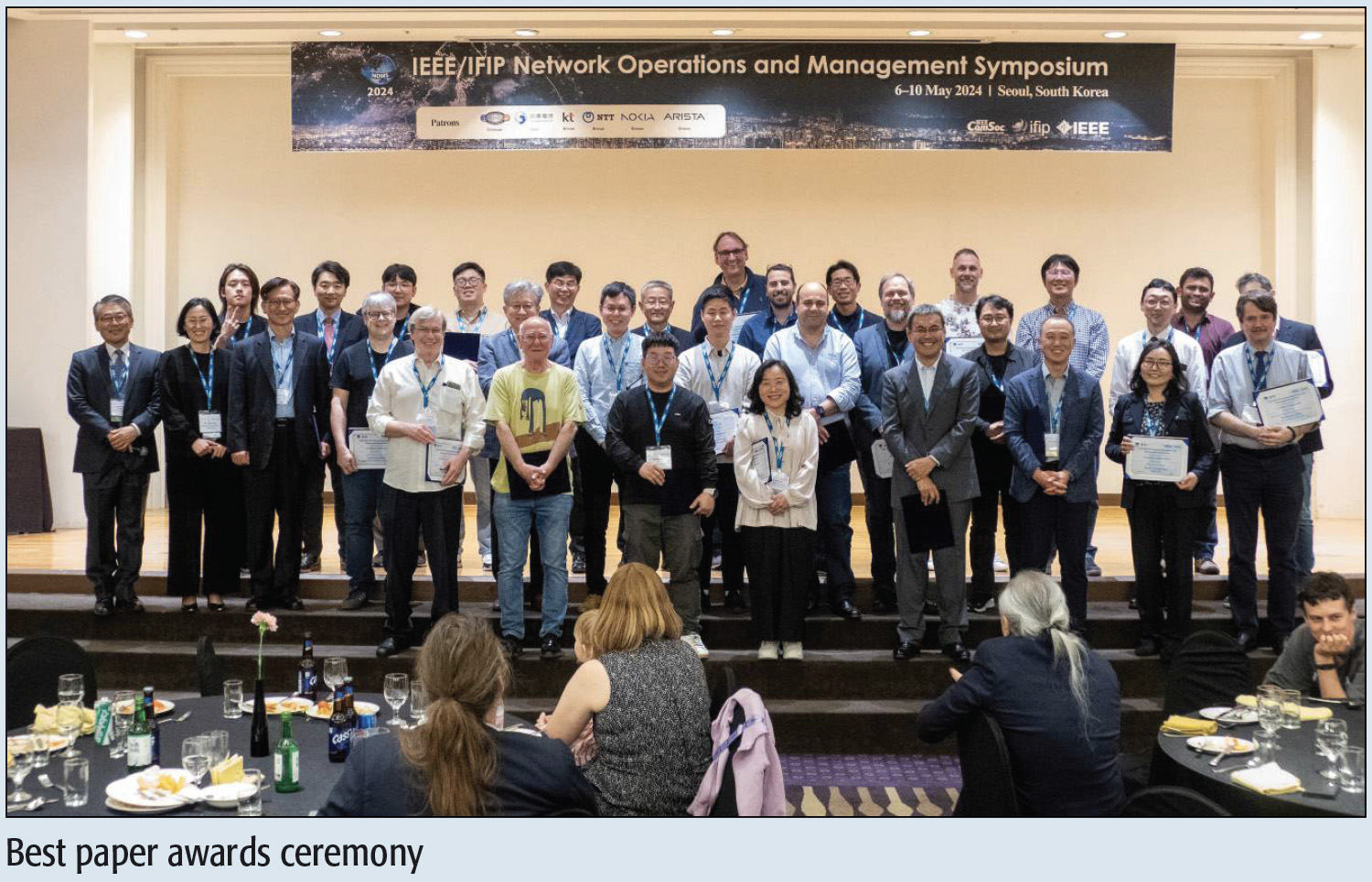
The Best Paper Award was presented to Nils Rodday, Gabi Dreo Rodosek, Aiko Pras, and Roland van Rijswijk-Deij from Research Institute CODE, Universitat der Bundeswehr Munchen, Germany, and University of Twente, Netherlands for their paper entitled, “Exploring the Benefit of Path Plausibility Algorithms in BGP.” The Best Student Paper Award was presented to Jesutofunmi Ajayi, Antonio Di Maio, and Torsten Braun from the Institute of Computer Science, University of Bern, Switzerland for their paper entitled “Drift-Aware Policy Selection for Slice Admission Control.“
Conclusion
NOMS 2024 was a big success in a number of ways. We had 350 people attending from 31 countries, one of the largest in recent years of NOMS. We had 98 organizing committee members from around the world performing various duties for the success of the conference. Participants engaged in insightful keynotes, detailed technical sessions, and had opportunities to interact with cutting-edge research and industry developments. The participants enjoyed the conference not only with excellent technical programs but also with a variety of sumptuous Korean food and Korean culture via the K-Pop girl group performance. Many said that NOMS 2024 was the best conference they ever attended.