The 32nd edition of the IEEE International Symposium on Local and Metropolitan Area Networks (LANMAN) was held in Tempe, Arizona, USA, on June 15 – 16, 2026. The symposium was hosted in the Memorial Union of Arizona State University at Tempe, Arizona, bringing together researchers, industry professionals, and academics from around the world to discuss the latest advances in local and metropolitan area networking. The venue for IEEE LANMAN 2026 was strategically selected to be close to Phoenix Sky Harbor International Airport and downtown, for people who wanted to see the city. LANMAN 2026 continued its long-standing tradition of providing an intimate and highly interactive forum that fostered technical discussions, collaboration, and networking among participants. The symposium attracted more than 40 attendees from academia, industry, and government research laboratories, and created a vibrant environment for exchanging ideas and presenting cutting-edge research results.
IEEE LANMAN 2026 focused on the theme of “Integrated Networking, Sensing and Communications for Next-Generation Wireless Networks,” with particular emphasis on emerging research directions and technological developments at the intersection of networking, sensing, and communication systems. The symposium featured a high-quality technical program covering both theoretical and experimental advances in local- and metropolitan-area networking, including highly relevant and timely topics such as wireless and mobile networking, edge computing, network security and reliability, software-defined networking, cloud networking, and next-generation communication systems.
Dr. Anna Maria Vegni and Dr. Parth Pathak, TPC Co-Chairs, along with the support of the rest of the Organizing Committee members, put together a 2-day technical program that brought together experts from industry, academia, and research to share their vision, as well as their achieved advances in the continuing evolution of local and metropolitan area networking. In keeping with the LANMAN tradition, the symposium’s single-track format encouraged active participation and extensive interaction among attendees, providing ample opportunities to discuss innovative and interdisciplinary research ideas.
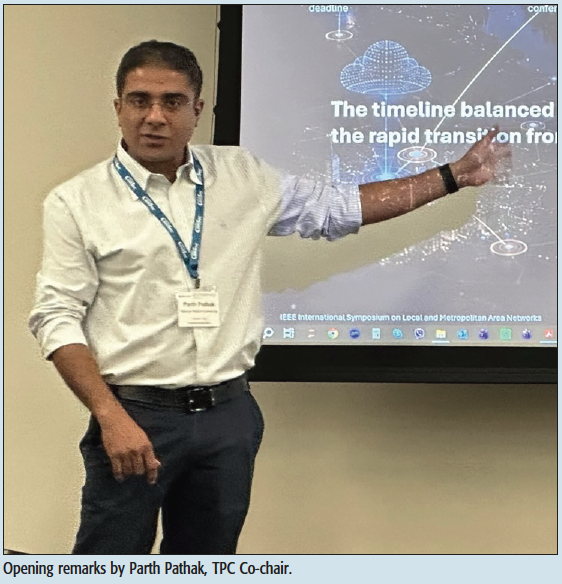
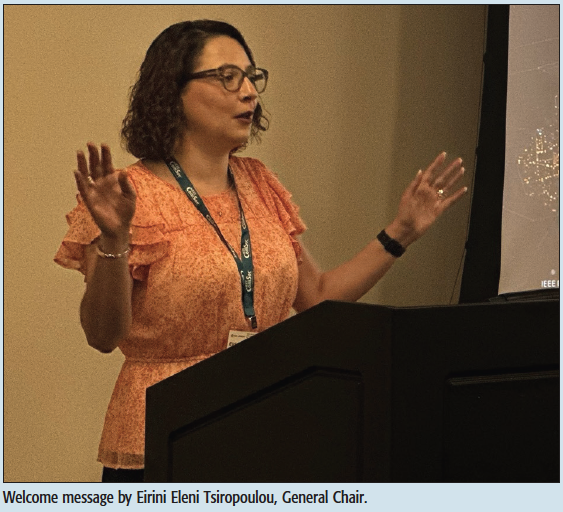
The first day of the conference began with the welcome message from Dr. Eirini Eleni Tsiropoulou, General Chair, and the opening remarks by Dr. Parth Pathak, TPC Co-Chair, who greeted the participants and highlighted the importance of continued collaboration within the networking research community. The technical program included paper presentations, keynote talks, and discussions on emerging challenges and opportunities in local- and metropolitan-area networking. Throughout the two-day event, the attendees engaged in lively exchanges of ideas, contributing to the success of LANMAN 2026 and reinforcing its role as a premier venue for networking research.
Two keynote talks were delivered by Dr. Kaushik Chowdhury (The University of Texas at Austin, USA) and Dr. Salil Kanhere (University of New South Wales, Sydney, Australia) on the first and second days of the conference, respectively, focusing on AI-native receivers and Cyber-Physical Sensor Networks. Specifically, Dr. Chowdhury delivered a talk titled “AI-Native Receivers: Testing, Lifelong Adaptation, and Practical Deployment in Cellular Networks,” and Dr. Kanhere analyzed the topic: “Adversarial Time Series Threats in Cyber-Physical Sensor Networks.”
A tutorial titled “Quantum Secure Next-Generation Networks: Post-Quantum Cryptography and QKD for 6G Security” was delivered on the first and second days of the conference by Dr. Abdullah Aydeger from the Florida Institute of Technology, USA, and Dr. Engin Zeydan from the Center Tecnològic de Telecomunicacions de Catalunya, Spain. The tutorial covered timely, highly relevant topics in post-quantum cryptography, quantum key distribution, and their integration into NextG and 6G network security. Dr. Sharief Oteafy and Dr. Cheng Li, the Tutorial Co-Chairs, coordinated the review and organization of the tutorial program. The tutorial attracted strong interest from participants and fostered an engaging environment for technical discussions on emerging security challenges in next-generation networks.
Regarding the technical program, four technical sessions were organized during IEEE LANMAN 2026, covering a wide range of timely and interesting topics, including AI-driven edge intelligence, distributed AI, resource optimization, programmable networks, O-RAN, SDN, network analytics, security, trust, quantum-resilient networking, wireless access, ISAC/UAV systems, sensing, and energy-aware networking. Six papers were presented in the first and third technical sessions. In contrast, five were presented in the second and fourth technical sessions, followed by questions and answers that engaged participants in lively, relaxed, and fruitful discussions. IEEE LANMAN 2026 received 45 review-scored submissions, out of which 22 papers were accepted for presentation and publication. All papers underwent a rigorous review process in which novelty, technical soundness, clarity, relevance, and overall contribution to the LANMAN community were carefully evaluated. The Best Paper Award was awarded based on review scores, TPC nominations, originality, technical depth, relevance to the conference scope, validation quality, clarity, and potential impact. The paper “PQ-CKEM: Efficient Quantum-resistant Group Key Creation for Large-Scale LEO Satellite Networks,” co-authored by Yacoub Hanna, Maryna Veksler, and Kemal Akkaya, received the Best Paper Award, which was announced during the closing remarks on the second day of the conference.
Several social events took place in the 2-day LANMAN conference. On the evening of the first day, a banquet was held to welcome all the participants to the conference. During the banquet, the participants engaged in fruitful discussions. Refreshments were offered to the participants throughout the conference, including food, beverages, and coffee breaks.
The preparation of the IEEE proceedings was handled by Dr. Dimitrios Michael Manias, Publication Chair, while Aruzhan Sabyrbek, Web Chair, managed the IEEE LANMAN 2026 website. Dr. Aris Leivadeas, Publicity Chair, supported the conference’s publicity. The Organizing Committee would also like to sincerely thank all the members of the organizing team for their valuable contributions, including Dr. Wenfei Wu, General Co-Chair, Dr. Anna Maria Vegni and Dr. Parth Pathak, TPC Co-Chairs, Dr. Abdallah Shami and Dr. Ahmed Refaey Hussein, Posters, Demos, and PhD Forum Co-Chairs, and Dr. Sharief Oteafy and Dr. Cheng Li, Tutorials Co-Chairs. All members of the Organizing Committee and Steering Committee are listed on the LANMAN 2026 website: https://lanman2026.ieee-lanman.org/. Finally, the Organizing Committee would like to thank the volunteers who supported the local arrangements and smooth execution of the two-day conference, including Aruzhan Sabyrbek, Debaleena Chakraborty, Dimitrios Kaltsogiannis, K. M. Rumman, Nick Mastorakis, and Sai Harsha Nimmagadda.
The Organizing Committee received very encouraging comments from participants regarding the conference’s technical program and its excellent organization. The Organizing Committee would like to thank all the Technical Program Committee members, the authors, the keynote speakers, and all the participants for making IEEE LANMAN2026 a remarkable experience and memorable event.