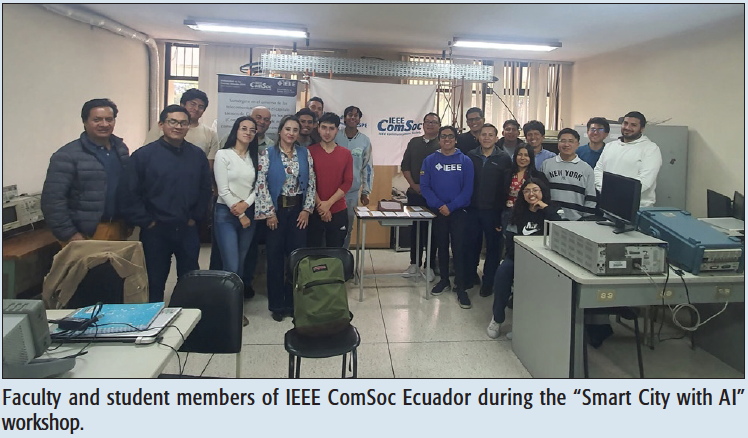
IEEE ComSoc Ecuador organized the “Smart City with AI: Designing the Electronic Future” workshop at Universidad de las Fuerzas Armadas — ESPE, bringing together faculty and student members to explore how artificial intelligence (AI) is shaping the future of smart cities. Held on October 1st, 2025, this hands-on session introduced practical ways to integrate advanced AI tools with Design Thinking for sustainable urban innovation.
The workshop, led by Dr. Lena Ivannova Ruiz Rojas, a distinguished member of IEEE Women in Communications Engineering (WICE), brought together 22 participants from IEEE ComSoc Ecuador. Through interactive exercises, attendees developed intelligent public infrastructure concepts — such as AI-driven public lighting systems — to enhance safety, optimize energy use, and promote environmentally responsible city design. Dr. Ruiz Rojas emphasized the value of creativity, collaboration, and technical innovation in addressing real-world urban challenges.
The event exemplified IEEE ComSoc Ecuador’s ongoing commitment to linking emerging technologies with societal needs, empowering the next generation of engineers to design the electronic future.
Workshop Activities and Design Thinking Approach
The workshop followed the Design Thinking framework, adapted for educational innovation. Faculty and students formed small interdisciplinary teams and engaged in a storytelling scenario set in 2035, where they acted as engineers solving urgent city challenges in mobility, energy, and safety. By this immersive exercise, participants advanced through five key phases:
Empathize: Identify citizens’ needs and urban challenges.
Define: Formulate a focused problem statement, such as “How might we design an intelligent public lighting system that reduces energy consumption and increases safety?”
Ideate: Generate creative solutions through a combination of manual brainstorming and AI-assisted idea generation.
Prototype: Develop quick visual or functional representations of the chosen idea.
Test: Present and refine solutions through peer feedback.
Throughout the process, visual storytelling and collaboration were essential. Teams designed not only technical solutions but also human-centered narratives that reflected how their innovations could impact daily life in a Smart City. This dynamic, interdisciplinary format enhanced creativity, teamwork, and engagement among participants.
Smart City Focus and AI-Powered Tools
The workshop focused on smart city solutions that integrate electronics and AI, with intelligent public lighting serving as the primary case study. These systems, equipped with sensors and AI algorithms, can adapt to environmental and usage conditions to optimize energy consumption and enhance public safety. Through this example, participants explored how electronic engineering contributes to sustainable urban development by designing sensor-based networks and AI-driven controllers that are responsive to real-time data. This hands-on approach provided valuable insight into modern urban infrastructure challenges and the intersection between communication technologies and city innovation.
To support rapid prototyping and insight generation, the workshop integrated artificial intelligence tools into the hands-on activities. Specifically, two AI-based platforms from Google were utilized: Google AI Studio and Notebook LM. Google AI Studio is an accessible online environment for AI experimentation, allowing users to design, test, and deploy machine learning models or applications, thereby fostering technical creativity in problem-solving. Notebook LM, on the other hand, is an AI-powered research notebook that can organize and summarize documents, helping learners quickly extract information and insights for their projects. Together, these tools provided an ecosystem that combines guided research with practical creation, ideal for electronics and telecommunications projects.
The AI tools were woven into the workshop exercises as creative aids. For instance, during the ideation phase, after brainstorming on paper, teams utilized Google AI Studio as a “co-ideation” partner, entering prompts to generate additional innovative ideas for their smart city challenge, thereby ensuring a wide exploration of solutions. This demonstrated how AI can augment human creativity by suggesting ideas that the team might not have considered. Later, in the prototyping phase, teams leveraged NotebookLM to organize their thoughts and even draft parts of their presentation script. At the same time, Google AI Studio was tasked with proposing catchy project names and slogans for their solutions. These AI-assisted steps not only accelerated the prototyping process but also introduced participants to new digital tools for engineering work. “The collaboration between humans and AI is key to unlocking new possibilities,” as the workshop material noted, underscoring the value of these tools in modern engineering education.
Impact and Future Relevance
This innovative workshop highlighted significant educational and professional benefits. By incorporating Design Thinking into a telecommunications and electronics context, the event fostered a creative mindset and user-centered approach among participants. Students and professors alike practiced “learning by doing,” tackling a realistic urban problem with guidance from a structured methodology. The use of AI tools as part of the process demonstrated to future engineers how to leverage emerging technologies for increased efficiency and innovation in their work. Many participants noted that the experience improved their teamwork skills — they had to communicate effectively, distribute tasks, and build on each other’s ideas, mirroring real engineering project environments.
The success of “Smart City with AI: Designing the Electronic Future” reflects its relevance for preparing the next generation of engineers. By working through a full cycle of problem-solving from empathizing with community needs to testing a prototype, attendees gained confidence in addressing open-ended, real-world challenges. The focus on smart city applications connects directly with pressing global trends in urban development, making the lessons learned especially pertinent.
As Ecuador and other countries pursue digital urban transformation and more intelligent infrastructure, these young engineers are now better equipped with the mindset and tools to make meaningful contributions. In summary, the workshop proved to be a valuable platform that strengthened academic training and stimulated innovation in telecommunications engineering education. It demonstrated how blending human-centered design with AI-driven tools can empower creative solutions, inspiring participants to continue designing the electronic future of smart cities.