Having seen a relative shortage of specialized amateur radio stations in Spain and Portugal — those who actively participate in Winlink Global Radio Email® network, sometimes also supported by APRS™ (=Amateur Packet Reporting System), I planned a DLP tour to both countries, coordinated with Prof. Javier Prieto, Chair of IEEE Spain SPS & ComSoc Joint Chapter.
The lectures took place at Universidad Carlos III de Madrid in Leganes, at Universidad de Valladolid and Universidade da Beira Interior in Covilhã, at the Instituto de Telecomunicações in Lisbon, from 13 to 21 April 2026.
The first talk was given on April 13 at Universidad Carlos III de Madrid, where Prof. Victor P. Gil Jimenez introduced me. The chosen topic was “Environmental Monitoring.” There were a small number of attendees, all Ph.D. students. It was an opportunity for me to give the students some ideas on possible further contribution to the local or regional amateur radio community, by installing weather stations or just simple atmospheric sensors, and release their outputs (i.e., monitored values of, for example, temperature, humidity, precipitation, wind direction, etc. to ‘the air’ by using amateur radio transmitters. In that direction, I had plenty of technical devices for introducing those who did not have prior experience with portable radio systems, ad hoc antennas, and related equipment. My visit to Madrid-Leganes concluded with a lunch with Victor and Prof. Ana Garcia-Armada.
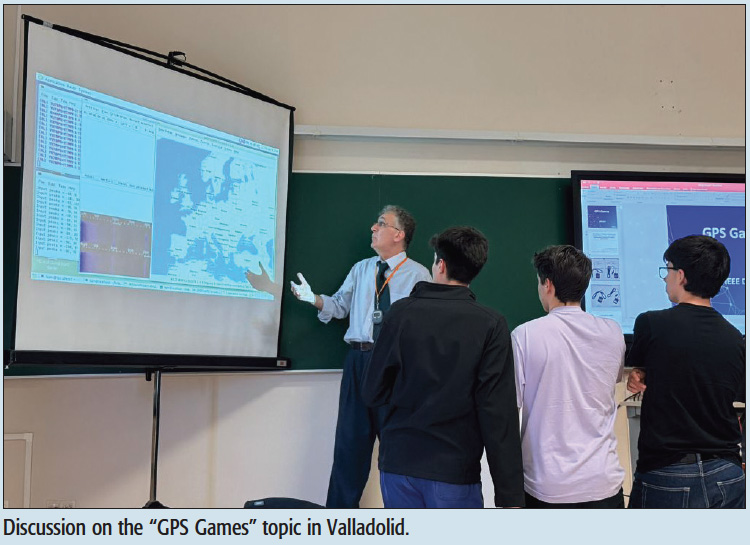
My second lecture set was held on April 16-17, so it was distributed over two days. The venue was the Universidad de Valladolid, and my talks were introduced by Prof. Javier Prieto of the University of Salamanca and Prof. Ramón de la Rosa of Valladolid University, who was also an active radio amateur, EA1GTH. The first topic was “Environmental Monitoring.” Once again, I provided a good display of various amateur radio instruments. The number of attendees was about 12, including 10 students and 2 teachers from a secondary school. After a break, my session continued with a discussion of the topic “GPS Games.” At some point, the audience changed, and a group of national and international university students in Telecommunications Engineering (members of the academic radio club) took their seats. I arranged a simulated demo consisting of a VHF ground-plane antenna, Sirio GPA 135–175, and an HF antenna, Radioddity HF-010. At the same time, Sirio SD 2000/U (a VHF/UHF combo), as well as Alpha Antenna MIL 2.0 and DXCommander Rapide, were introduced by slides. An innovative version of the antenna coaxial cable, Messi & Paoloni’s “Tactical Solutions,” and a data radio modem, LiNK500, completed the portfolio for both lecturing days.
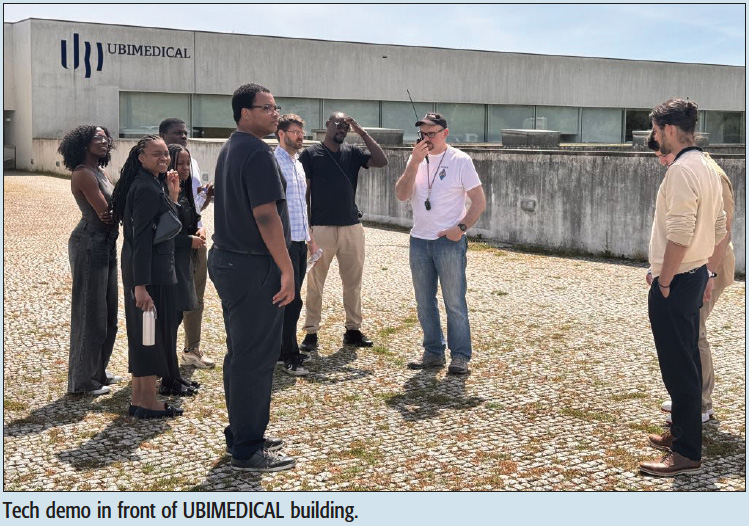
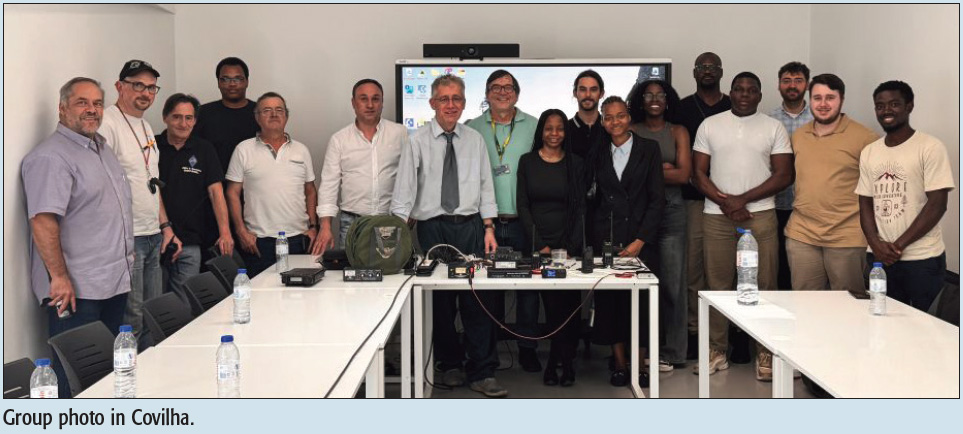
After finishing my DLP activities in Spain, I took a bus ride to Covilha, Portugal, where my host was Prof. Fernando José da Silva Velez of Instituto de Telecomunicações / DEM, Universidade da Beira Interior in Covilhã, and Vice-chair of the IEEE Portugal ComSoc chapter. There, I also had two days of lectures spread over April 19-20. The first day, I gave a morning talk on “GPS Games.” At the same time, the afternoon topic was “Environmental Monitoring,” followed by practical activities in the form of an outdoor radio demonstration. The number of attendees was about 15 per session (including radio amateurs from that part of Portugal, academic staff, and students). As Prof. Velez had kindly invited a group of radio amateurs to join us, those guys came well-equipped with portable radios for display & demo.
Furthermore, Prof. Velez organized a hearty lunch for all participants at the UBIMEDICAL — Telecommunications Laboratory. The second day’s lecture was devoted to amateur radio equipment for possible emergencies under the topic “Hands-on Antennas.” This talk was given at another location, in a meeting room of Universidade da Beira Interior in Covilhã.
During my DLP tour, I experienced some health issues, but had to continue the journey to Lisbon by taking another 3+ hour bus ride.
The final lecture was scheduled for April 21 at the 11th floor of North Tower — Instituto de Telecomunicações in Lisbon, hosted by the officers of IEEE Portugal ComSoc Chapter, António M. R. C. Grilo (Chapter Treasurer) and Luis Filipe Bernardo (Chapter Secretary), who took care of arranging my presentation via Zoom video-conference to allow virtual attendees from their ‘sister ’ chapter in Seattle, USA. The plan was not to record the session for offline access, but to allow people in Seattle to participate and ask questions remotely. So I gave my consent to that plan. Preliminary, there were 6 registrations for the Lisbon presentation: 2 in-person attendees and 4 virtual attendees (3 using a Univ. of Seattle e-mail and 1 additional attendee from Washington state.
Thankfully, the Spanish and Portuguese telecommunication authorities granted two special-event radio identifiers, EH4MPB and CR6MPB, on time to celebrate this ComSoc DLP tour on domestic and international amateur radio bands. The tightly compressed tour schedule did not allow enough time for radio communications in the voice spectrum; however, a few contact attempts with local enthusiasts have been examined. Unfortunately, my presentation & travel program was tailored too tightly to allow for cultural opportunities in either country, such as city sightseeing or museum visits. However, there were occasional culinary experiences by tasting local food: Javier Prieto invited me for Spanish ‘tapas’, while Fernando Velez invited me to a family dinner prepared by Mrs. Velez at their home.