I successfully completed an IEEE ComSoc Distinguished Lecture Tour (DLT) in Japan this past August. The trip coincided with a conference, making it a wonderful opportunity to reconnect with old friends, meet new colleagues, engage with researchers, educators, and students, and experience the hospitality of my Japanese hosts.
During this DLT, I delivered three talks, scheduled as follows:
-
Talk 1: Institute of Liberal Arts and Sciences, Nagoya University, Nagoya, Japan — hosted by Dr. Takaya Yamazato (Chair, IEEE ComSoc Tokyo (Joint) Chapter), August 1, 2025
-
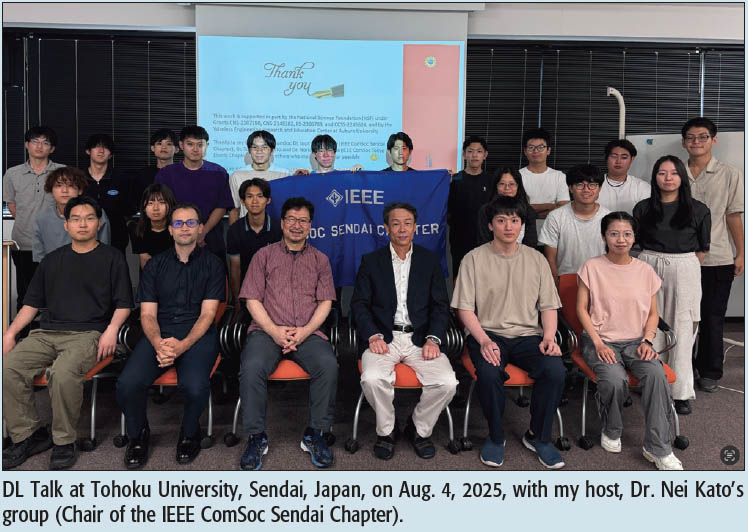
Talk 2: Graduate School of Information Sciences, Tohoku University, Sendai, Japan — hosted by Dr. Nei Kato (Chair, IEEE ComSoc Sendai Chapter), August 4, 2025
-
Talk 3: Osaka Ibaraki Campus (OIC), Ritsumeikan University, Osaka, Japan — hosted by Dr. Noriaki Kamiyama (Vice Chair, IEEE ComSoc Tokyo (Joint) Chapter), August 8, 2025
The talks were titled “Generative AI–Empowered RF Sensing for 3D Human Pose Tracking.” The content was tailored for each event to better align with the interests and backgrounds of the respective audiences.
The talks were primarily based on our recent research on machine learning–empowered wireless sensing. One aspect focused on how various radio frequency (RF) signals can be used to sense and interpret human activities. The other explored how to effectively apply machine learning models to process RF signal data and, importantly, how to make these models less dependent on large amounts of wireless data—thereby reducing the effort required for RF data collection.
In this work, we investigated AIGC (AI-generated content) approaches to generate labelled synthetic RF data for multiple wireless sensing platforms, including WiFi, RFID, and mmWave radar. Our methods feature conditional Recurrent Generative Adversarial Networks (R-GANs) as well as diffusion and latent diffusion models. We also propose a novel framework that leverages latent diffusion transformers to synthesize high-quality RF data and accurately infer missing skeletal joints, enabling the reconstruction of full 25-joint human poses from partial (e.g., 12-joint) inputs.
The talks were well received, attracting both on-site and remote attendees. The audience included students, faculty members, and researchers from within and beyond the specific research area. I had engaging and insightful discussions with participants during the sessions, which helped me better understand ongoing challenges and refine how I present complex technical concepts to a broader, multidisciplinary audience.
In addition to the DLT talks, I also attended the 34th International Conference on Computer Communications and Networks (ICCCN 2025), held from August 4–7, 2025, in Tokyo, Japan. ICCCN is one of the leading international conferences for presenting novel ideas and fundamental advances in the fields of computer communications and networking. I presented an invited paper and thoroughly enjoyed the rich technical program, which featured three keynotes, two panel sessions, and numerous interesting presentations.
Japan’s high-speed rail system — the Shinkansen — proved to be incredibly convenient. At first, it’s easy to feel confused by the many companies and lines that make up Japan’s public transportation system. However, after a few rides — and with helpful tips from local friends — it quickly becomes intuitive, making transfers and travel remarkably smooth. It allowed me to stay in Tokyo, travel tßo other cities for my talks, and return the same day. I also greatly enjoyed sampling the wide variety of bento boxes available on the trains.
On August 6, I visited the National Institute of Information and Communications Technology (NICT) to meet with colleagues and explore opportunities for research collaboration. I was particularly impressed by NerveNet, a resilient, distributed wireless and mobile access network system developed by Dr. Yasunori Owada’s group.
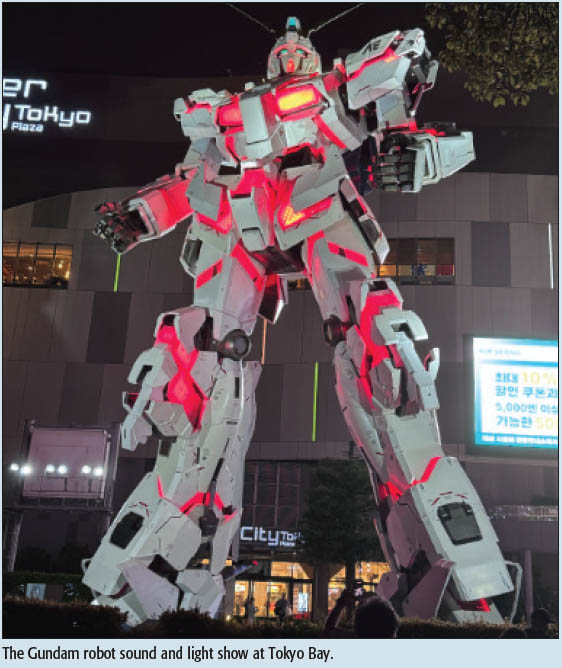
The DLT also gave me the chance to reconnect with many friends working in Japan, as well as international colleagues attending ICCCN 2025. I came away with many unforgettable memories—from exploring the vibrant food streets of Shinjuku, visiting real-life locations featured in Japanese anime around Tokyo, to spending peaceful moments by the beautiful Tokyo Bay.
ComSoc’s DL Program is highly regarded by its members. It plays a key role in advancing knowledge and fostering innovation through high-quality lectures delivered by leading experts. In addition to serving members by disseminating new technologies, the program is highly rewarding for the Distinguished Lecturers themselves, enhancing the visibility and impact of their work while fostering new ideas and collaborations. Moreover, the DL Program serves as an important platform for collaboration between the ComSoc’s Technical Committees, which nominate the Distinguished Lecturers, and the local chapters, where the DL talks are delivered.