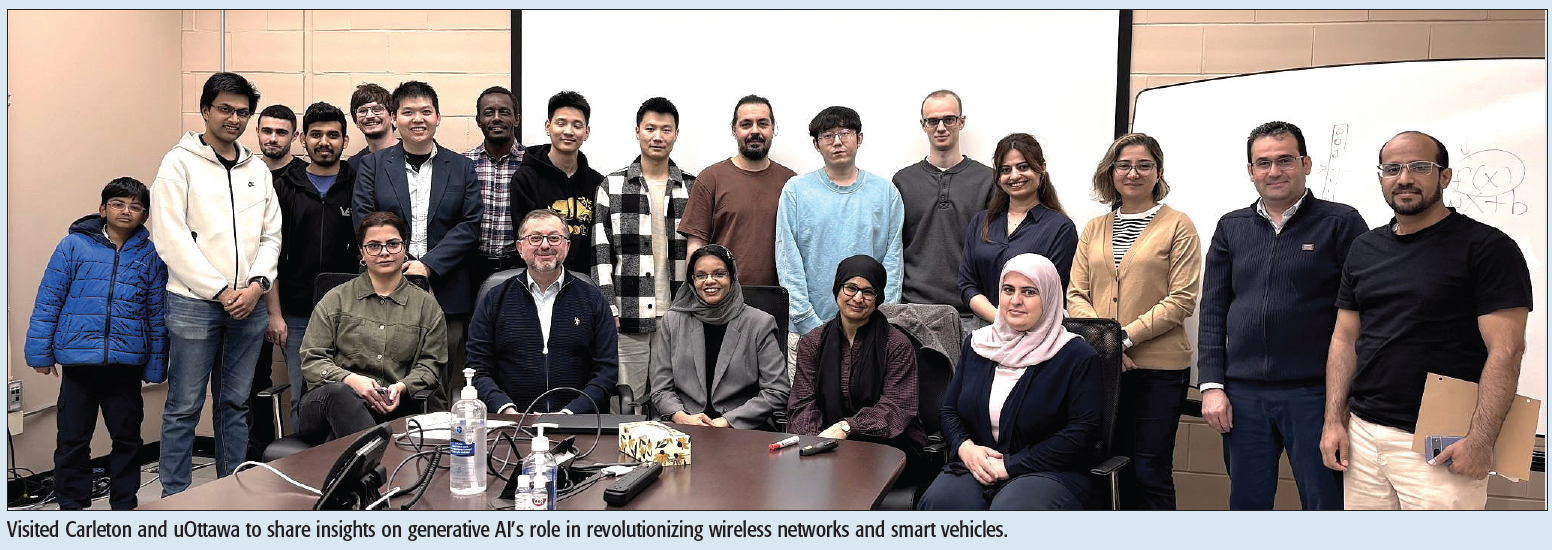
I successfully completed an IEEE ComSoc Distinguished Lecture Tour (DLT) to three Canadian cities (Montreal, Ottawa, and Kingston) in late May 2025. Overall, the experience was enriching, combining the joy of sharing my work with engaged academic audiences, the inspiration drawn from stimulating discussions, and the pleasure of connecting with peers and friends across these vibrant cities.
Each stop on the tour brought something unique: a warm welcome, deep academic conversations, and rich cultural moments. The discussions were not only intellectually fruitful but also helped spark new research ideas. The hospitality and professionalism of the hosting professors made the tour seamless and enjoyable.
During this DLT, I delivered four invited talks:
-
Talk 1 at Concordia University on 20th May 2025, Montreal, hosted by Prof. Anader Benyamin-Seeyar, P. Eng., Ph.D., on “Generative AI and Deep Learning for Resource Allocation in Wireless Networks”
-
Talk 2 at Carleton University on 21st May 2025, Ottawa, hosted by Prof. Halim Yanikomeroglu, on the same topic
-
Talk 3 at the University of Ottawa on 22nd May 2025, delivered on short notice thanks to the quick arrangement by Prof. Burak Kantarci and Prof. Melike Erol-Kantarci, titled “Driving Smarter: How AI Language Models Are Shaping the Future of Connected Vehicles”
-
Talk 4 at Queen’s University on 23rd May 2025, Kingston, hosted by Prof. Francois Chan, titled “Self-Supervised Learning for Wi-Fi Sensing: Trends, Challenges, and Outlook”
Each talk explored a key aspect of how artificial intelligence, especially generative models and self-supervised learning, can impact the design and optimization of future wireless networks. I discussed practical applications ranging from efficient resource allocation to smart mobility and connected vehicle systems. Across all institutions, the talks drew enthusiastic attendance from graduate students, faculty members, and researchers, typically between 20 and 30 participants per session. Discussions after the talks were particularly valuable. For instance:
-
At Carleton, we explored the role of AI in open RAN (ORAN) systems.
-
At uOttawa, we delved into challenges deploying LLM-based inference in connected cars.
-
At Queen’s University, a vibrant Q&A followed on the robustness of self-supervised sensing approaches in complex environments.
These engagements have already sparked ideas I plan to explore in upcoming research collaborations and publications.
This tour also offered rich networking and cultural opportunities.
I visited École de technologie supérieure (ÉTS) in Montreal, where I met Prof. Wael Jaafar and Prof. Bassant S. and toured their labs. It was a pleasure to reconnect with Prof. Rami Langar virtually. I deeply appreciated the warm hospitality extended by my long-time friend Sunila Akbar, who travelled from another city just to attend my talk in Ottawa.
A memorable moment was a Japanese lunch in Little Italy arranged by Prof. Jie Gao, where I connected with fellow researchers Hao Zhou, Chengming Hu, and Zijiang Yan.
While the tour was tightly scheduled, I caught glimpses of each city’s character—from the academic bustle of Montreal and Ottawa to the tranquil charm of Kingston. Although brief, these cultural impressions added depth to my journey.
Looking back, the DLT was more than a speaking tour — a vibrant mix of academic exchange, idea generation, and cross-institutional collaboration. It reaffirmed the importance of in-person engagement and its impact on advancing research and building community.
I strongly encourage my fellow researchers to consider becoming an IEEE ComSoc Distinguished Lecturer. This program promotes our field across borders and provides an invaluable platform to connect, collaborate, and contribute to shaping the future of communications and networking.
With collective efforts and shared passion, we can drive innovation and inspire the next generation of researchers worldwide.