Having seen an opportunity to support the development and usage of APRS (Amateur Packet Reporting System), as a predecessor of Internet-of-Things (IoT), across Baltic countries, I planned a tour to the region, coordinated with Prof. Kalle Tammemäe, C/Com/IT Joint Chapter Chair, IEEE Estonia Section. Three venues were selected as the lecture hosts: VilniusTech (Vilnius Gediminas Technical University), EAVA (Estonian Aviation Academy, EAA), and TalTech (Tallinn University of Technology).
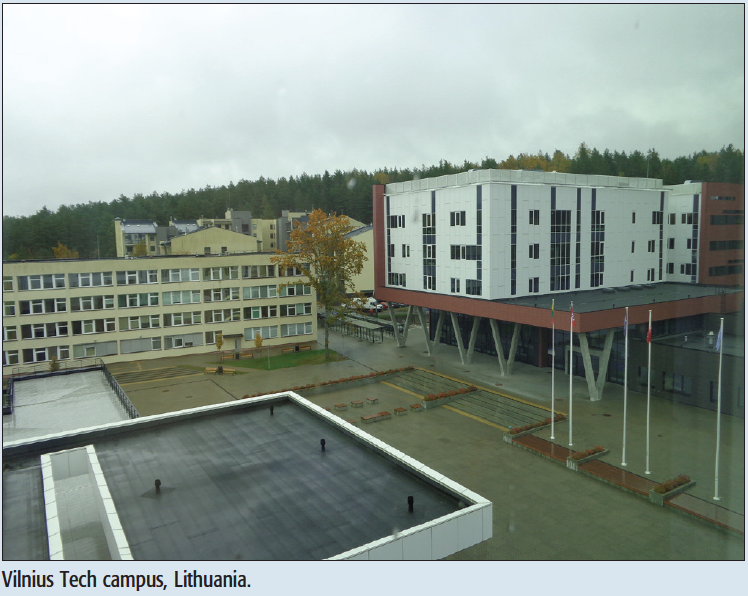
The first talk was given on October 17 at VilniusTech and was introduced by Prof. Arturas Medeika.is the Dean of the Faculty of Electronics. My lecture was divided into two sessions, 12:10-13:45 (“GPS Games”) and 14:30-16:05 (“Environmental Monitoring”). The number of attendees was about 15 per session (academic staff and students). The presentation included various situations where the precise position of a radio user would be of vital interest, particularly during an emergency after natural or man-made disasters. Furthermore, the APRS (Amateur Packet Reporting System) enables monitoring of atmospheric conditions and data telemetry — all of this without the use of any data link from commercial or governmental media.
APRS appeared in the early 1990s as an amateur radio system for multilateral information sharing on what was happening in a geographical area, and has been continually upgraded with new features. Today, APRS includes weather-related information, movable objects information (car traffic), road works, nearby gasoline stations, announcements for incoming radio amateur gatherings, home locations of radio ‘hams’, repeater frequencies, and so on. The primary purpose of APRS is to help radio amateurs who travel through unknown territories (E.g., foreign countries or remote states/provinces within their own country) to feel comfortable by looking at the display of their mobile (vehicle) transceivers (or even hand-held amateur radios) — without any need for cell telephony or Internet providers. The system utilizes a single VHF radio frequency across a continent, eliminating the need for radio channel changes when crossing national borders.
My second talk was given on October 20 at EAVA, moderated by Mati Tarlap, Head of EAA’s Aviation Communication and Navigation curriculum. I had one lecture there from 12:30 to 14:00, and the chosen topic was “Hands-on Antennas.” Again, the number of attendees was about 15 (mostly academic staff and students). However, among the audience was Viljo Allik, a Leading Engineer at the Department of Space Technology, University of Tartu, and an active radio amateur, who shared his personal opinions on antenna topics, primarily focused on satellite communications. Thank you, Viljo, for your input! To prepare for the discussion, I arrived at the area one hour before the main event. The room was equipped with additional tables capable of displaying a temporary antenna and hosting a passive demo. This time, it was a VHF ground-plane model, the Sirio GPA 135-175. At the same time, the Sirio SD 2000/U (a VHF/UHF combo) and the Alpha Antenna MIL 2.0 and DXCommander Rapide (both vertical designs intended for amateur radio HF bands) were explained through slides. Additionally, an innovative version of the coaxial antenna cable, Messi & Paoloni Ultraflex 7 “Sahara,” completed the introductory portfolio for this lecture.
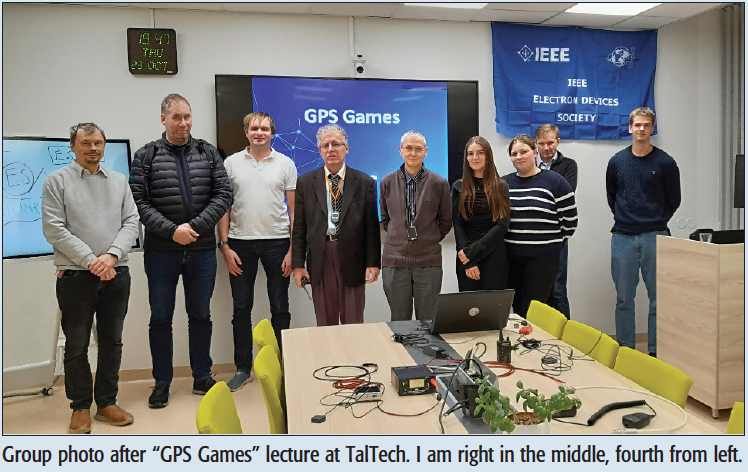
The third talk was done on October 23 at TalTech, hosted by Kalle Tammemäe, C/Com/IT Joint Chapter Chair, IEEE Estonia Section. My program was divided into two sessions, 14:00-15:30 (“Environmental Monitoring”) and 17:45-19:15 (“GPS Games”). The number of lecture attendees was about 12 per session (academic staff and students). The good atmosphere and vivid discussion prolonged the second session for more than half an hour. The audience was motivated to comment on malicious ‘GPS spoofing’ attacks that led to position inaccuracies. Prof. Marika Kulmar assisted in providing all technical presentation necessities for a quality visual demo on the chosen topics.
Thankfully, the Lithuanian and Estonian telecommunication authorities granted two special event radio identifiers, LY7MPB and ES1MPB, on time to celebrate this ComSoc DLP tour on domestic and international amateur radio waves. The tightly compressed tour schedule did not allow much time for radio communications in the voice spectrum; however, a few contacts with local enthusiasts have been made. In addition, I found some (relatively too short) space for exploring old cities’ streets and museums, which contributed to an excellent DLT experience. I highly recommend the Distinguished Lecturer Program to fellow researchers as it benefits professional growth and the ComSoc community.
Miroslav Skoric <skoric@ieee.org>