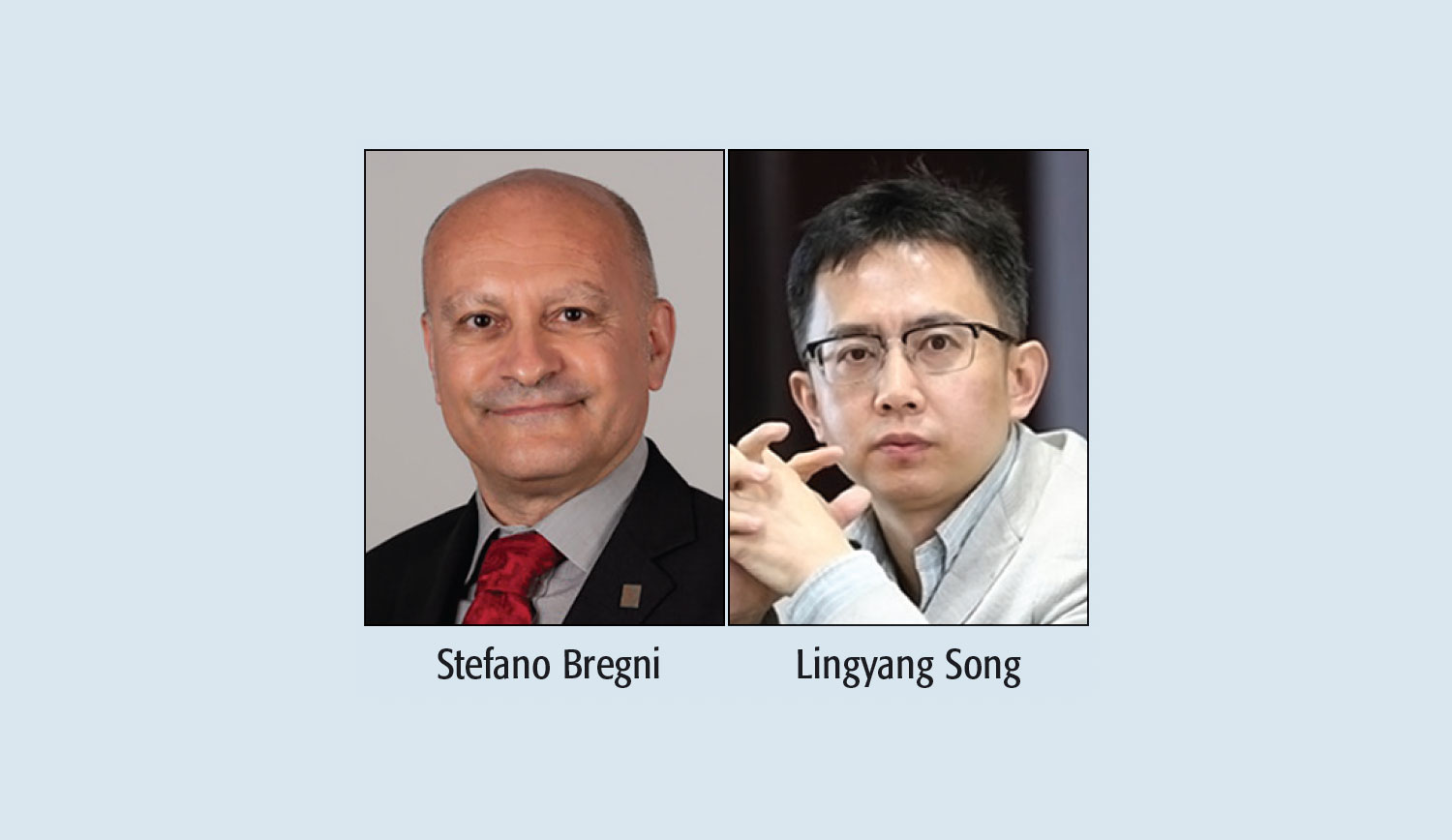
This article continues the series of ten interviews with the Officers of the IEEE ComSoc Member and Global Activities (MGA) Council for the term 2024–2025, which is published every month in the Global Communications Newsletter.
In this series of articles, I introduce the Vice-President and the six Directors of the MGA Council (namely: Member Services, Industry Outreach, and AP, NA, LA, and EMEA Regions), as well as the three Chairs of the Women in Communications Engineering (WICE), Young Professionals (YP), and Sister Societies Standing Committees. In each interview, one by one, they present their sector activities and plans.
In this issue, I interview Lingyang Song, IEEE ComSoc Asia Pacific (AP) Region Director.
Lingyang Song received his Ph.D. from the University of York, United Kingdom, in 2007, where he received the K. M. Stott Prize for excellent research. He worked as a research fellow at the University of Oslo, Norway, until rejoining Philips Research UK in March 2008. In May 2009, he joined the Department of Electronics, School of Electronics Engineering and Computer Science, Peking University, and is now a Boya Distinguished Professor. His main research interests include wireless communication and networks, signal processing, and machine learning. He was the recipient of the IEEE ComSoc AP Young Researcher Award in 2012, the IEEE ComSoc Leonard G. Abraham Prize in 2016, the IEEE ComSoc Heinrich Hertz Award in 2021, and the IEEE ComSoc AP Outstanding Paper Award in 2021. He is a fellow and a distinguished lecturer of the IEEE.
Stefano: Hello Lingyang! Please, would you introduce a bit of the Asia Pacific Region and Board to our readers?
Lingyang: The IEEE ComSoc AP Board (APB) offers an exceptional platform for stimulating, coordinating, and promoting the activities of ComSoc members and Chapters throughout the AP region.
The AP Region has grown to be the largest in number of members and geographical area in IEEE ComSoc. The AP region now accounts for 42% of ComSoc members (AP/World = 10,575/25,242 in 2023). Besides ComSoc, the AP region now accounts for 41% of IEEE members (AP/World = 187,221/460,709 in 2023).
This is your first time serving as IEEE ComSoc AP Region Director. How was your first impression when you were appointed? And on the first days after you started serving in your new position? What was the first difficulty you faced?
I have long-time service experience for IEEE ComSoc APB, beginning in 2013 as the Vice Chair of the Membership Development Committee (MDC). I subsequently held roles as Vice Chair and then Chair of the Technical Affairs Committee (TAC) until 2021. Following that, I served as the Vice Director of APB, mainly responsible for TAC, until 2023. Upon being appointed as the APB director in 2024, my first impression was a profound sense of honor and responsibility. The opportunity to lead and represent such a distinguished board filled me with both excitement and a deep sense of duty.
In the first days after starting my new position, I was warmly welcomed by an incredibly supportive and enthusiastic team. Perhaps the first difficulty I encountered was the need to enhance the APB platform to encourage more ComSoc members to join. From 2022 to 2023, the number of ComSoc AP members has decreased from 11,649 to 10,575 (–9.2%). Addressing this decline and finding ways to boost membership is one of the top priorities for me as the new APB Director in 2024.
What are the most difficult challenges that you face in the AP Region?
One challenge that I face in the AP region is to increase the membership. As mentioned earlier, the region has seen a decline in membership. Reversing this trend and increasing member engagement, especially in under-represented geographical regions, is a top priority.
Another challenge that I face is to enhance diversity, especially to help junior researchers and women researchers in their career progression. It’s crucial that we create an inclusive environment that encourages and nurtures talent from all backgrounds.
Furthermore, the rapid pace of technological advancements, particularly in areas such as artificial intelligence, presents both an opportunity and a challenge. AI has recently made a profound impact on the fundamental principles and key technologies of wireless communications, and we must stay at the forefront of these developments.
The Distinguished Lecturer Program (DLP) and the Distinguished Speaker Program (DSP) are particularly appreciated by our Members. What are your most recent activities under these ComSoc Programs?
Annually, the Chapter Coordination Committee (CCC) of APB collaborates with the IEEE AP office in running the Distinguished Lecturer Program (DLP). DLP provides the means for ComSoc chapters to identify and arrange lectures by renowned experts on communications and networking-related topics.
In 2024, notable lectures included “Reconfigurable Intelligent Surfaces for Communications and Radar” by Prof. Kumar Vijay Mishra, held in Kolkata, Guwahati, Silchar, Balasore, Bhubaneswar, and Jabalpur, “Enabling Terahertz Communications for 6G and Beyond Wireless Networks” by Prof. Nan Yang, held in Seoul, Yokohama, Osaka, and Taipei, and “Security Enhancements of 5G Wireless Networks/Security Enhancements of the Internet of Things/Security Enhancements of NDN Networks” by Prof. Maode Ma, held in Canberra and Townsville.
What are other membership activities in the AP Region that you consider most significant and you would like to highlight in particular?
Each year, the Technical Affairs Committee (TAC) of APB selects winners for the AP Young Researcher Award and the AP Outstanding Paper Award. The AP Young Researcher Award honors young active researchers in IEEE ComSoc publications and conference activities over the last 3 years, and the AP Outstanding Paper Award honors outstanding original papers authored by members in the AP region over the last 3 years.
The Women in Communication Engineering Committee (WICEC) of APB was newly created in 2022 to promote the visibility and roles of women communications engineers in the AP region. It promotes WICE activities to make connections among women researchers and increase the number of young women researchers. The number of IEEE Women Members in the AP region increased from 36,219 to 43,776 (+20.9%) from 2022 to 2023, and the AP region comprised 55.7% of IEEE women members (AP/World = 43,776/78,612) in 2023.
The AP WICE Outstanding Achievement Award was newly established in 2024. This new award recognizes women engineers of IEEE ComSoc from the AP region who have done outstanding technical work and achieved high visibility in the broad field of communications engineering.
The Young Professionals Committee (YPC) of APB seeks to engage young professionals and students in the communications disciplines through educational workshops and professional development activities. Many seminars and workshops are held to facilitate the exchange of insights and experiences between distinguished researchers and young professionals every year.
As an example, YPC hosted a seminar in Beijing, China, on August 10, 2024, where many inspiring talks were presented, such as “How IEEE ComSoc can Help Your Career Development” by Prof. Sherman Shen (former president of ComSoc), “Emerging WLANs Technology: Future Directions and Open Challenges” by Prof. Nei Kato (chair of ComSoc Sendai chapter), “Deep Learning based Radio Map for MIMO and Cell-Free Massive MIMO” by Prof. Wei Zhang (vice president of ComSoc), “AIGC for Wireless Data” by Prof. Shiwen Mao (member-at-large of ComSoc board of governors), and “Task-Oriented Semantic Communications with Modularized Communication-Learning Co-design” by Prof. Angela Zhang (member-at-large of ComSoc board of governors).
To conclude, what are your plans for 2025?
To take the APB to the next level of excellence, the APB team will work closely to provide better services to members in the dynamics of the membership and technical areas. Specifically, we aim to expand our membership base, with a particular emphasis on underrepresented geographical regions.
Furthermore, we intend to foster the growth of ComSoc’s technical areas through interdisciplinary research. We also plan to enhance diversity and inclusion among participants in ComSoc activities, helping junior researchers and engineers in their career progression.
Finally, we are committed to strengthening the communication platform for all AP regional members, facilitating connections and exchanges. Overall, we will become even more proactive in APB activities.