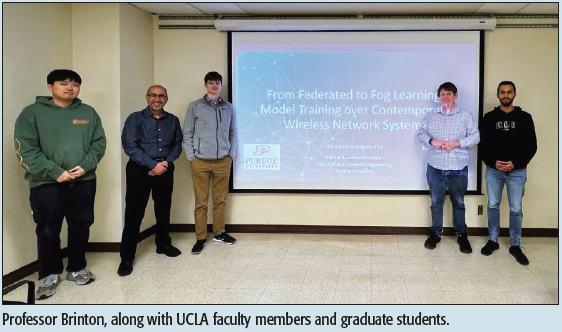
In a recent IEEE Communications Society (ComSoc) Distinguished Lecture Tour (DLT), Professor Christopher Brinton, an expert in artificial intelligence (AI) and communication systems at Purdue University, visited the IEEE Buenaventura/Coastal Los Angeles Chapters and the University of California, Los Angeles (UCLA). His DLT provided valuable insight into the emerging paradigm of Fog Learning.
Prof. Brinton’s talk focused on a new approach to addressing the challenges of distributed model training over dynamic and heterogeneous networks. Unlike traditional distributed AI techniques such as Federated Learning, Fog Learning considers fog networks’ unique characteristics, including computing elements spanning from the edge to the cloud. A key aspect of his talk shows how local topologies, dynamically formed among groups of heterogeneous computing elements, result in a tradeoff between intelligence quality and communication efficiency.
Dr. Kambiz Shonarinejad hosted the visit to UCLA. At UCLA, faculty members and graduate students engaged in discussions on distributed training over wireless networks and some of the tough challenges with Edge AI. The stop at UCLA was added due to a last-minute change in Prof. Brinton’s itinerary.
The author, Dr. Victor Lin, hosted the visit to the Buenaventura/Coastal Los Angeles Chapters at the Aerospace Corporation. At Aerospace, attendees from industry explored the potential of the Fog Learning framework in mission-critical applications. Prof. Brinton provided examples of Fog Learning for systems with dynamic topologies, such as integrated space-terrestrial networks.
Some highlights from Prof. Brinton’s lecture include:
-
The necessity of adaptive, topology-aware machine learning models in fog networks.
-
The challenges and future directions in the Fog Learning research and implementation.
As a hosting chair, I found that the IEEE DL Program (DLP) coordination process requires good communication skills and flexibility in adapting to last-minute changes. Although Prof. Brinton’s DLT stop in SoCal had some unexpected challenges, the event successfully introduced Fog Learning concepts to a wider audience outside the research community. I believe that the DLP can help bridge the gap between academia and industry by bringing together industry practitioners and academics to exchange knowledge on recent technological advances. It is my hope that the DLP will foster closer collaboration between academia and industry.