From 9th November to 14th November 2025, I had the privilege of delivering a series of IEEE ComSoc Distinguished Lectures across Karnataka, India — visiting Bengaluru, Mysuru, and Shivamogga at the invitation of the IEEE Bangalore Chapter.
A Lecture Tracing 30 Years of Innovation
My lecture, “From Networks to Intelligence — Lessons from Three Decades of Communication R&D for the Age of AI”, explored the evolution of communications and computing — from the era of national telephony to the rise of the Internet, cloud, and mobile systems, and today’s age of AI and generative intelligence.
I first reflected on the era when national carriers and their laboratories, such as NTT, AT&T Bell Labs, and others, served as the “guardians of innovation,” shaping global communications through rigorous CCITT/ITU-T standards grounded in trust and engineering discipline. I then discussed the Internet era and the IETF’s culture of “rough consensus and running code.”
From there, I revisited Moore’s Law, emphasizing that its true meaning lies not in transistor scaling alone, but in the exponential coevolution of hardware and software. Semiconductor advances enabled faster processors and larger memory, which, in turn, enabled new software paradigms. Software innovations then demanded new hardware architectures — creating a reinforcing cycle that has driven decades of exponential progress. This synergy is even more evident in today’s AI landscape. Modern generative AI does not emerge solely from GPUs; it relies fundamentally on deep learning software frameworks. Without this “software infrastructure,” large-scale models like Transformers would simply not be trainable. Thus, today’s AI revolution is the culmination of hardware innovation built on top of a long-standing software civilization. I argued that this ongoing co-evolution represents the modern form of Moore’s Law: the exponential amplification of human creativity through smarter hardware, richer software ecosystems, and collaborative innovation across disciplines.
Introducing My Research: Applying Machine Learning to Network Operations
In the latter part of the lecture, I introduced several of my research projects that apply machine learning to network operations and cybersecurity. First, I presented our work on few-shot learning for eNodeB KPI analysis in LTE networks. With millions of KPIs generated daily across nationwide deployments, manual labeling is impractical. We use Prototypical Networks to detect anomalies with minimal labeled samples, and evaluations on production LTE traces. The second topic was a semi-supervised Network Intrusion Detection System based on Adversarial Autoencoders (AAEs). Because labeled attack data is scarce and rapidly outdated, our model extracts latent features for benign and malicious traffic using the GAN component of the AAE. I also highlighted our work on GPS trajectory annotation for urban mobility analysis, which classifies movement patterns — walking, transit, and other modes — and identifies points of interest using spatiotemporal clustering. Applied to GPS data from the Shibuya area of Tokyo, the method effectively captures urban mobility structures. Other research topics introduced in the talk include reinforcement learning for deadline-aware WAN data transfer, Bayesian population-based traffic prediction in mobile networks, and DID/VC-based secure data distribution architectures. Collectively, these projects illustrate how advanced ML techniques can enhance automation, resilience, and intelligence in modern communication networks.
A Journey Through Karnataka: Three Cities, Three Communities
It was my first time in India, and before departure, I wondered how smoothly I could travel across cities I had never visited and barely knew. Yet from the moment I arrived, every worry vanished: the coordination by the local hosts was flawless. Each lecture, transfer, and meeting flowed so seamlessly that I often felt as if I were a packet being segment-routed across an optimally engineered path.
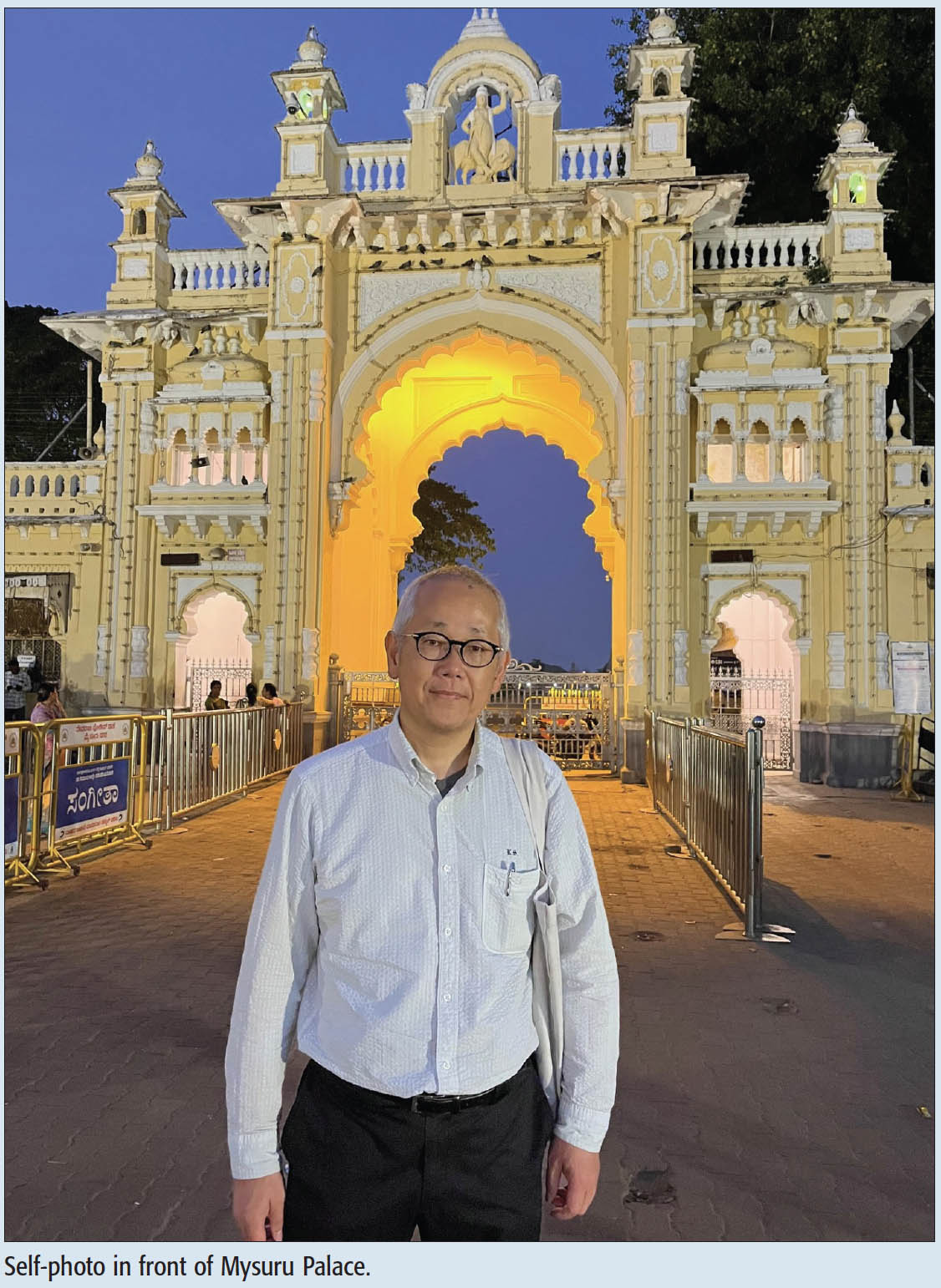
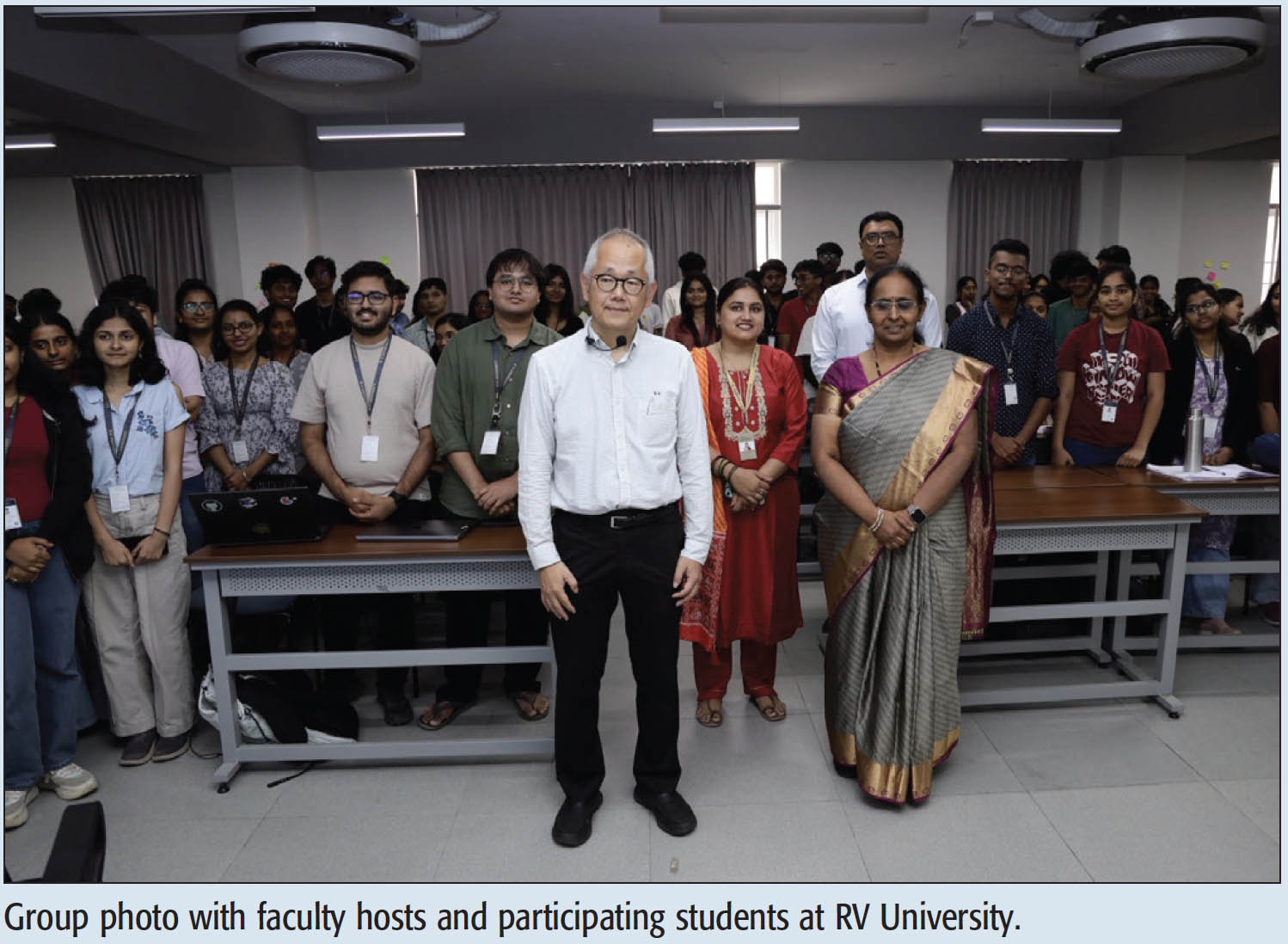
Tuesday: After lecturing at the RV University in Bengaluru (Photos 1 and 2), I traveled from Bengaluru to Mysuru via the highway, arriving before sunset. Mysuru — the historic capital of the Mysore Kingdom — impressed me with its long educational tradition. I visited the palace, a church, and local handicraft shops (Photo 3).
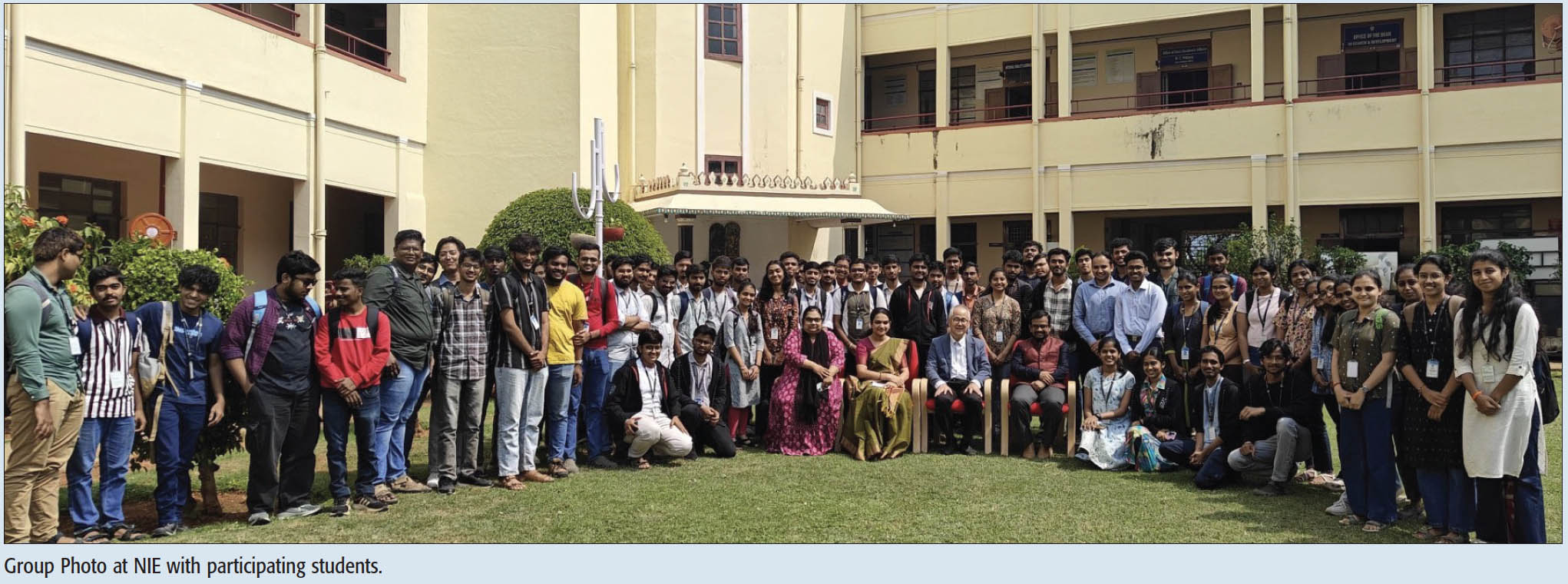
Wednesday: After my lecture at the National Institute of Engineering (NIE) in Mysuru (Photos 4 and 5) and lunch with students, I traveled 250 km from Mysuru to Shivamogga. The route revealed the beautiful rural landscapes of South India, making the long drive unexpectedly pleasant.
Thursday: After lecturing at the Jawaharlal Nehru New College of Engineering (JNNCE) in Shivamogga (Photo 6), I traveled another 270 km back to Bengaluru, passing through highways, local roads, and unpaved stretches before arriving late in the evening.
The DLT schedule was intense but inspiring. Each day involved more than six hours of driving after the morning lecture — truly a “tour.” Some roads were bumpy and unpaved, but this allowed me to experience the everyday life of South India more closely. I also deeply appreciated the warmth and kindness of the people I met along the way.
Student Energy and IEEE Spirit
Each university welcomed around 180 undergraduate students from electrical engineering, computer science, mechanical engineering, robotics, and related disciplines. Their enthusiasm, curiosity, and thoughtful questions made every session engaging. Many students also expressed a strong interest in studying or working in Japan.
I was especially impressed by how effectively each institution leveraged its IEEE Student Branch. Students took the lead in organizing the events, while faculty provided excellent mentoring. It was a powerful reminder of how IEEE empowers young engineers to develop leadership, communication, and professional skills.
A Lasting Impression
The sincerity and energy of the students, the warm hospitality of the hosts, and the cultural and historical richness of Karnataka left a lasting impression on me. I am grateful for the inspiration I received from the students, faculty, and volunteers of the IEEE Bangalore Chapter. In particular, I wish to extend my appreciation to the hosting institutions — RV University in Bengaluru, National Institute of Engineering (NIE) in Mysuru, and Jawaharlal Nehru New College of Engineering (JNNCE) in Shivamogga — for their warm welcome and exceptional organization. Their IEEE Student Branches played a central role in planning and executing the events, demonstrating impressive leadership, teamwork, and professionalism. Their efforts made each visit not only smooth and enjoyable but truly meaningful. This journey reaffirmed the strength of the IEEE community and the importance of international academic exchange.
I would also like to express my sincere gratitude to Professor Gnanapriya, Chair of the IEEE ComSoc Bangalore Chapter, for giving me this opportunity, and to Mr. Vishal Rathod, who served as the primary coordinator and flawlessly arranged every part of the tour from start to finish.
I look forward to bringing the energy and insights gained from this experience back into my research and education activities in Japan.