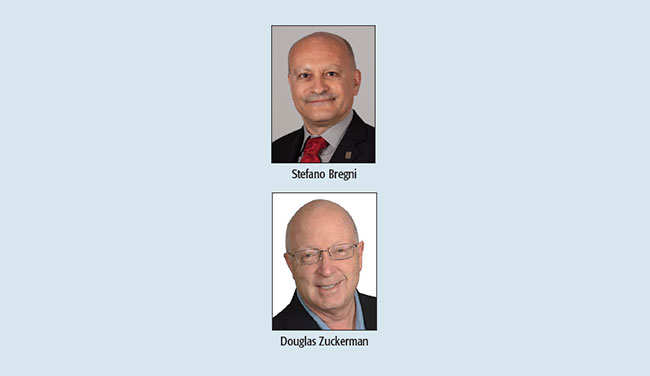
Today, I have the great pleasure to interview Douglas Zuckerman, IEEE ComSoc Communications History Committee Chair. Doug has been a great friend of mine for a long time since my first steps in ComSoc. He is the ComSoc President who introduced me to the Board of Governors when he appointed me Director of Education in 2008, already a far-off year. He helped me a great deal at that time, showing me the ropes and making me feel at ease in a world that was completely new to me. Currently, he serves as Chair of the ComSoc Standing Committee on Communications History.
Dr. Doug Zuckerman, an IEEE Life Fellow, is on the IEEE Future Directions Committee, where he co-chairs its Public Safety Technology initiative. He also chairs the IEEE New Initiatives Committee, which fosters innovation for the benefit of humanity. In addition, he serves on the IEEE Standards Association Board of Governors and chairs the association’s Fellow Nominations Support Committee. Earlier, he served as the IEEE Communications Society President and our division’s IEEE Board Director. His BS, MS, and Ph.D. degrees are from Columbia University (USA). His earlier work at Bell Labs (and successors) heavily influenced network management standards and implementation.
Stefano: Hello Doug! What a pleasure to interview you today! Would you like to begin by introducing the Communications History Committee?
Doug: From the Society’s Bylaws, “This Committee is responsible for identifying, placing in electronic archives, and raising public awareness through all appropriate means of the most important facts, people, and achievements of communications history, as well as telecommunications milestones in general.”
Stefano: What is the current composition of the Communication History Committee?
Doug: Due to the wide range of activities envisioned for this committee, the committee currently has about a dozen members with the following roster:
Committee Roster
Chair | Doug Zuckerman (2024-2025)
Members
2024–2025 | Kit August, Stephen Weinstein, Doug Zuckerman
2024–2026 | Celia Desmond, Dave Michelson, Curtis Siller
2025–2027 | Shri Goyal, Mehmet Ulema, Mathini Sellathurai
2025–2025 | Martha Steenstrup
Staff | Cynthia Sikora
This team includes former ComSoc Presidents, past Communications Magazine EiC’s, a past History Committee chair, the IEEE History Committee chair, several Life Members, and founders of some of the earliest ComSoc flagship conferences, as well as organizers of more recent ones.
When I first became chair in 2022, the ComSoc Bylaws limited the committee to 3 voting members. Since then, the Bylaws have raised the voting membership to 9 (plus any number of non-voting members, as needed). The committee meets virtually each month.
Stefano: Certainly, your committee includes very well-known volunteers of ComSoc, with a long record of service in our Society. What initiatives have you and the committee conducted during your term as chair?
Doug: Examples of our activities have included solicitation of articles on Communication History for our magazines, organizing communications history sessions at conferences, identifying technology milestones, conducting oral histories and commemorating significant anniversaries of the IEEE Communications Society, and of course our ComSoc 70th Anniversary panel at IEEE GLOBECOM 2022, as well as our ongoing collaborations with AT&T Labs with “Days at the Museum” in celebration of the ”Big Bang” theory and Telstar. The latter included local high school students as part of a STEM outreach.
More explicitly, the committee focused on the following initiatives:
-
Communications History Book — Added another decade to the history of communications technology to commemorate the 70th anniversary of ComSoc.
-
Interactive Communications History — Created an interactive guide at the Society’s website showing key “milestones” in communications.
-
IEEE Milestones — Identified, proposed, and collaborated with the IEEE History Committee on new IEEE milestones.
-
Oral Histories — Conducted interviews in adherence to IEEE History Committee and ComSoc History Committee policies and procedures.
-
Conference History — Started maintaining histories of our major and portfolio conferences, especially GLOBECOM/ICC, NOMS, etc.
-
Presence at IEEE GLOBECOM and ICC — Organized and moderated history panels and had exhibit hall presence at our flagship events.
-
History Column in IEEE Communications Magazine — Initiated a column on communications history, including “a look back” and an extensive history of amateur radio.
-
Update Web Presence — Participated in updating the ComSoc website to make the history pages easier to navigate.
-
Collaboration and Engagement — Provided a history perspective in line with IEEE strategy and policy, as well as through ComSoc’s Women in Communications Engineering committee and support of young professionals.
-
Participation in Significant Anniversaries — Helped organize and participated in anniversaries such as the 100th anniversary of Bell Labs, and the 50th anniversary of OFC (Optical Fiber Communications and Networking Conference).
-
Communications Outreach and STEM — Worked with the local IEEE section and AT&T Labs in leveraging the discovery of the Big Bang and the first Telstar satellite to stimulate interest in STEM among local high school students. This also included visits to the AT&T Labs museum, which showcased early communication artifacts.
- History Wikipedia — Provided updates to ComSoc and communications technology history on Wikipedia, also aiming at making our history easier to find.
Stefano: You served as Chair of the Communication History Committee for two terms, from 2022-23 to 2024–2025. If you look back at these four years, what has been the most difficult challenge you faced, if any? And what achievement makes you most proud of? Is there anything you would like people to remember about you?
First and foremost was growing the committee from just three members to nearly a dozen. Working with the committee, we developed around a dozen initiatives that have a visible presence across the Society and beyond. I am most proud of the enthusiasm shown by the committee members, as well as the support given by ComSoc’s VP Technical and Educational Activities, Wei Zhang, his Technical and Educational Activities Council, and the Board of Governors. The most difficult challenge had been working with the committee to operationalize its activities from among many good ideas coming from its members. I would like people to remember the growth and visibility accomplished during the past four years.
Stefano: Your second and final term is now nearing its end. As your term nears completion, what are your thoughts for the Committee on moving forward in 2026 and beyond? I am confident that the next Chair, who will be appointed for the 2026-27 term, will appreciate receiving your advice and suggestions.
Doug: First, I would continue the committee’s activities on its current initiatives, which have been described in the August 2025 President’s Page. These initiatives have included memorialization of deceased colleagues, an interactive communications history, oral histories, a user-friendly web presence, the Communications Magazine history column, proposing and supporting new IEEE milestones, and other history-centric activities.
In addition to continuing with the relevant current initiatives, if I were still Chair for the next term, I would consider exploring the following new, and possibly more difficult, initiatives:
-
Personalized History — You may recall that in my previous articles, I shared some personal recollections and stated, “The Members are the History.” Also, hearing recollections from others at various “celebrations,” such as the 100th anniversary of Bell Labs, showed how individuals embraced sharing their own personal histories, as well as hearing those of others. Perhaps we could launch a history blog. At a high level, we know the significance of Telstar as an early milestone in communications history, but what about hearing from those who were directly involved with making it happen? We’ve done that for Telstar, so how about doing it for other “big” historical events?
-
Historic Artifacts — History can come to life by viewing early communications artifacts, such as the Telstar satellite in the AT&T museum in New Jersey. We should broaden the reach of our artifacts to other places that host similar artifacts. An example is the various ham radio conventions (also known as ham fests) that feature gear from the early days of communications. Even if we are unable to obtain the actual artifacts, perhaps we could expand ComSoc’s Interactive Timeline to include links to such artifacts, museums hosting communications-relevant content, and other relevant resources. Hosting displays at our conferences and conducting side tours to museums near our events would also support the showcasing of historic artifacts.
-
Technical Committee History — ComSoc’s Technical Committees have a rich history that we may be losing as time moves on. Perhaps a handful of colleagues and I may recall when our Committee on Network Operations and Management (CNOM) was established during the previous century. I remember the ComSoc Technical Activities Council meeting where it was created, as well as the first Chair and other officers from its early years. I suggest that each TC include a function aimed at capturing its history before it’s too late.
-
Outreach — Possibly in concert with the IEEE History Committee, engage with entities outside of ComSoc that have history initiatives. Such entities may include universities, companies, non-profit associations, and other IEEE Societies. The initiatives may include museums or archives, corporate museums and celebrations, and volunteer organizations such as the Radio Club of America (not to be confused with the Radio Corporation of America, historically also known by the acronym “RCA”). Our local chapters can play a key role in this outreach.
Stefano: Do you have any closing thoughts on moving forward?
Doug: Yes, I do have some:
During my nearly two terms as committee chair, there has been substantial movement towards a “Culture of History” in many of its activities. To further enable this culture, the committee should consider using either available or to-be-developed tools to help collect and curate historic data, making it useful to the Society, its members, and even beyond. Such tools could also help identify trends that may impact the direction of ComSoc activities. Although I prefer not to limit myself to a specific technology, Artificial Intelligence with proper human oversight ought to be considered.
I also believe that volunteers who make exceptional contributions to ComSoc’s historical activities should be recognized. Perhaps the ComSoc Awards Committee could consider creating an award for this purpose.
In terms of priority for the current and possible future initiatives, I would continue the current ones (stated in the previous answer) as the highest priority — they have been working well and align closely with the committee’s charter. Next, I would launch new initiatives, such as personalized history, Technical Committee history, historic artifacts, and expanded outreach. Last but not least, the committee should consider its role in celebrations, recommend the creation of a “history” award to ComSoc’s Awards Committee, and increase the use of tools (such as AI or other) that will ease the collection and curation of relevant communications history.
In closing, I would like to thank the history committee members for their efforts in defining and bringing many of our initiatives to fruition over the past four years. Also, thanks to Vice Chair Kit August and staff lead Cyn Sikora, whose dedication and support played a crucial role in advancing our activities. Lastly, thank you, Stefano Bregni, for inviting me to this interview.