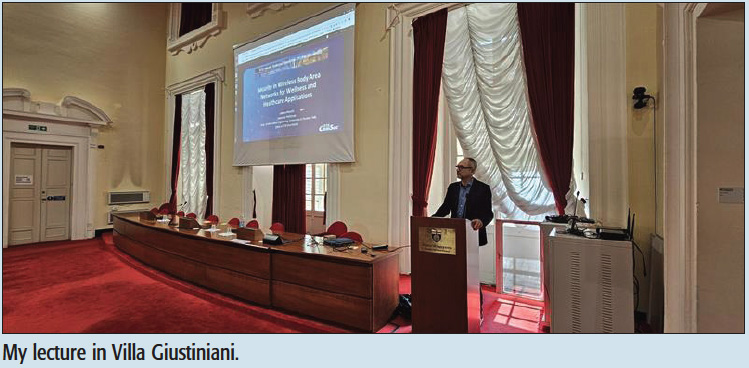
In the historic port city known for its maritime legacy, a different kind of navigation took center stage at the 2025 IEEE ComSoc eHealth TC PhD School: navigating the future of healthcare through secure wireless technologies. I had the opportunity to present a Distinguished Lecture on Security for Wireless Body Area Networks (WBANs), a topic I’ve been working on for several years, particularly in the context of physical layer techniques.
The lecture took place in Villa Giustiniani-Cambiaso, a Renaissance villa located in Genoa, now home to the Polytechnic School of the University of Genoa. Designed in 1548 by Galeazzo Alessi for the noble Luca Giustiniani, the villa is a landmark of 16th-century architecture, characterized by its tripartite structure and elegant loggias. If you have ever visited Genoa, you probably remember it more for the alleys where the sun does not give its rays than for the sea that creeps into the city. Genoa has long been a gateway to discovery; its sailors and merchants charted new routes across the Mediterranean and beyond, laying the foundations for global trade and exploration that still echo in the city’s cultural and academic life today. The setting offered a unique blend of historical prestige and academic vision, providing an ideal backdrop for discussions on cutting-edge healthcare technologies.
WBANs, comprising wearable and implantable sensors, are becoming increasingly central to modern healthcare systems. They enable continuous monitoring of physiological parameters, such as heart rate and EEG signals, and offer promising solutions for remote assistance and cost reduction. These systems are not only innovative but also becoming essential in addressing the challenges posed by aging populations and the need for sustainable healthcare.
One of the key points I emphasized during the lecture is that security in WBANs cannot rely solely on traditional cryptographic methods. These methods, while effective, are often too demanding for the low-power devices typically used in body area networks. I presented examples of real-world vulnerabilities, including attacks on implanted medical devices and ransomware incidents in hospitals, to illustrate the urgency of the issue.
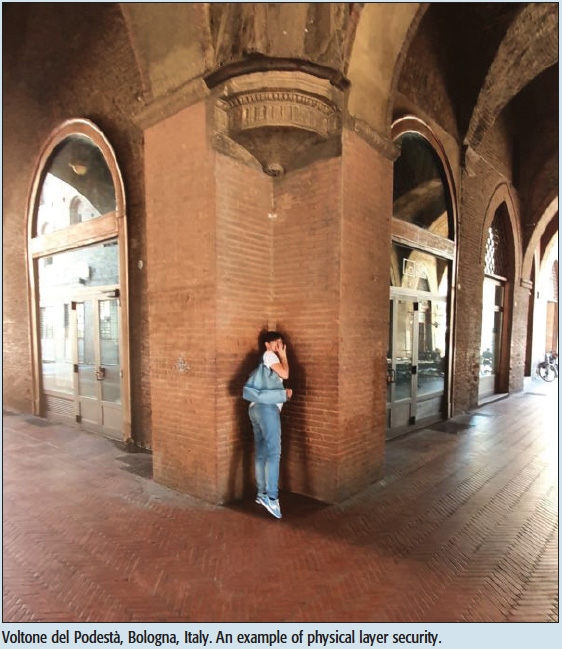
To address these challenges, I introduced the concept of Physical Layer Security (PLS), which embeds security directly into the transmission process. PLS leverages channel characteristics, noise, and interference to ensure confidentiality without relying on computationally heavy encryption. I used the acoustic phenomenon of Bologna’s Voltone del Podestà, where whispers travel along columns but remain inaudible to those in the center, as a metaphor for secure communication at the physical layer.
The lecture included several practical applications of PLS, such as noise-loop modulation for confidentiality, EEG-based authentication, and galvanic coupling, where human tissue itself becomes a secure transmission medium. These techniques are not just theoretical; experimental results and peer-reviewed publications support them. I also envisioned WBANs not just on the body, but inside it, looking ahead in the era of Internet of bio-nano-things, letting the audience insight that security must evolve with technology, and PLS is our compass in this journey.
I also discussed the importance of standardization, highlighting the ETSI SmartBAN initiative, which integrates secure modes and PLS into its framework. This is a crucial step toward ensuring interoperability and widespread adoption of secure WBAN technologies.
From my perspective as a Distinguished Lecturer, the experience was both stimulating and rewarding. It provided a valuable platform to share research, engage with young researchers, and reflect on the broader implications of our work. The DLP program itself is an excellent initiative, as it fosters dialogue across institutions and disciplines, helping to bridge the gap between academic research and practical innovation.
As the audience left the lecture hall, I hoped they carried with them not only technical insights but also a sense of the strategic importance of security in healthcare innovation. The future of WBANs is not just about connectivity, it’s about trust, resilience, and intelligent design.